
Convenience comes at a cost that is not always clear from a product’s sales tag.
With cars and planes, a large part of that cost is the environmental toll the vehicles continue to take. But with electric scooters — which have the potential to reduce transport’s toll on the environment — the cost is felt through an alarming growth in road injuries.
To draw attention to the dangers that come with the pleasure and convenience of e-scooter use, ERideHero analyzed the latest available figures on electric scooter injuries in the U.S. and identified the trends these injuries are following.
What We Did
We used electric scooter injury data from the United States Consumer Product Safety Commission’s NEISS Database, which collects data from a sample of over 100 American ER departments, to extrapolate estimated injury figures for the whole of the U.S. We sourced the global data on electric scooter road accidents manually from reputable news sources.
We test every ride
Independent reviews, buying advice and the real test data behind them. Straight to your inbox.
Join 2,000+ riders


Key Findings
- The proportion of all e-scooter injuries involving children rose from 15.3% to 17.5% in the past 12 months.
- The number of preschool children injured by e-scooters fell in 2025, but the number of 11 to 14-year-old injuries doubled to 18,207.
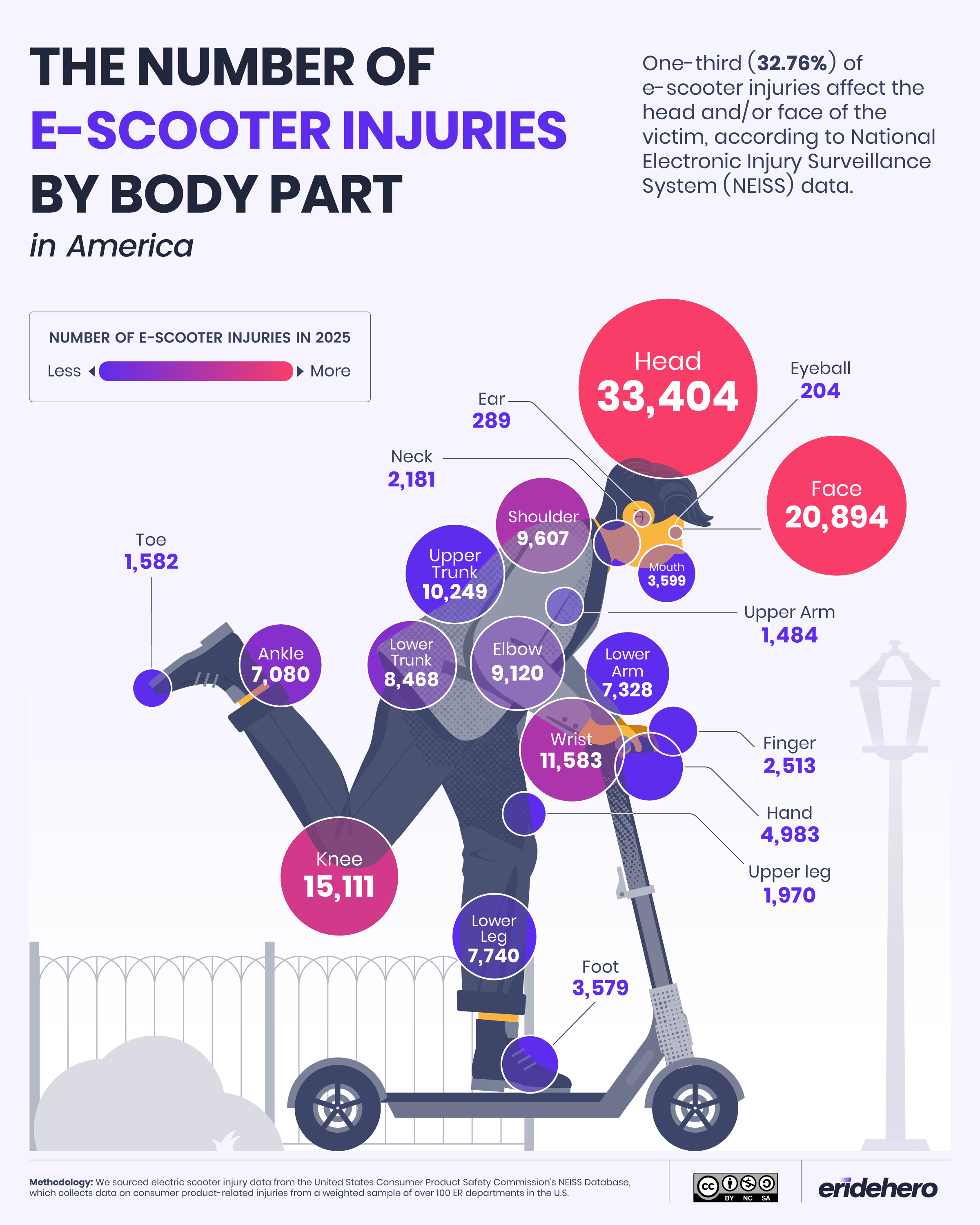
- 33,404 (or 20.2%) of all electric scooter injuries in 2025 involved head injuries.
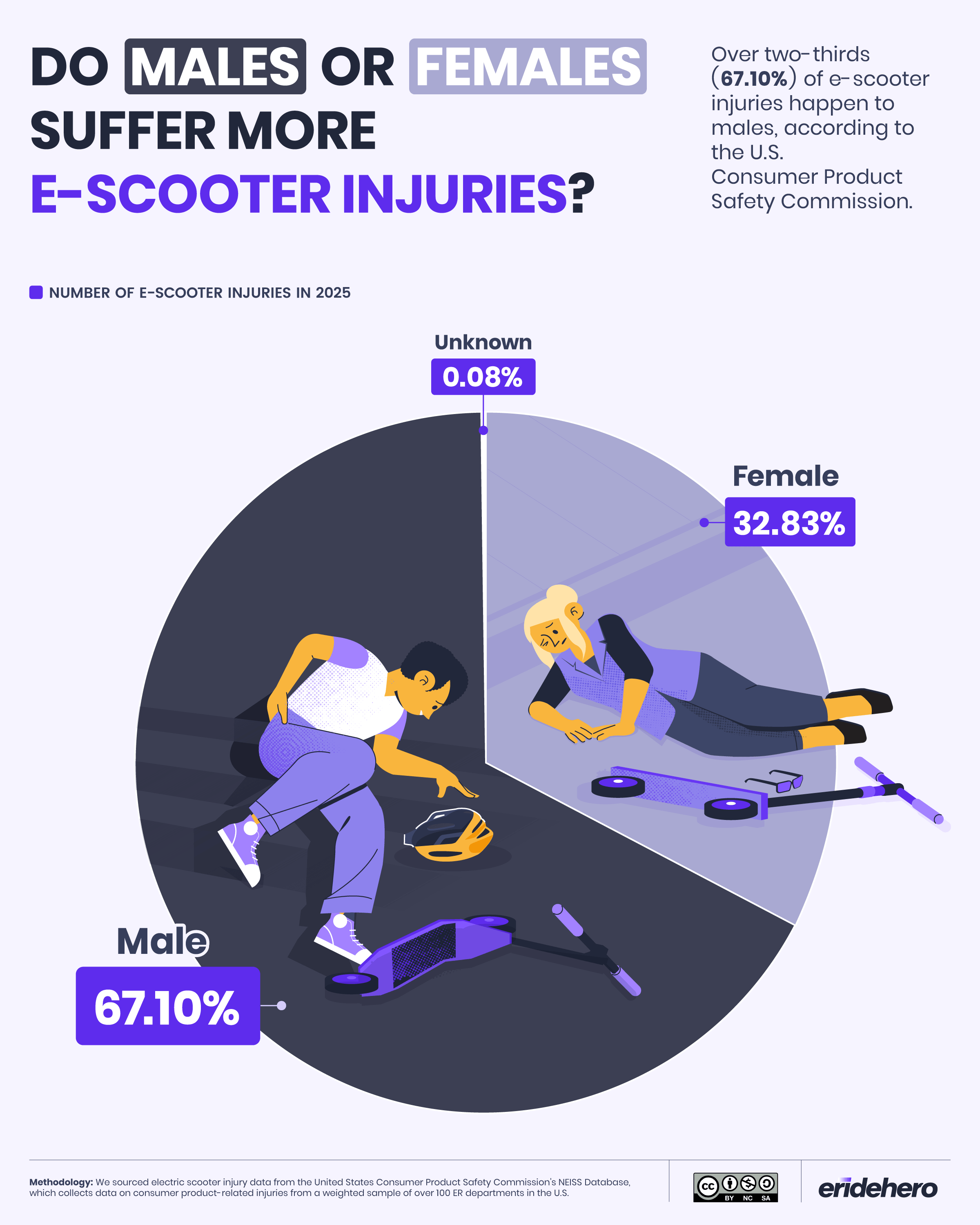
- Some 67.1% of electric scooter injuries in 2025 happened to males — almost exactly the same proportion as in 2024.
- New Zealand had 755 electric scooter road accidents per million people in 2025, which is more than any other country.
Electric Scooter Injuries Rose by 43% Last Year
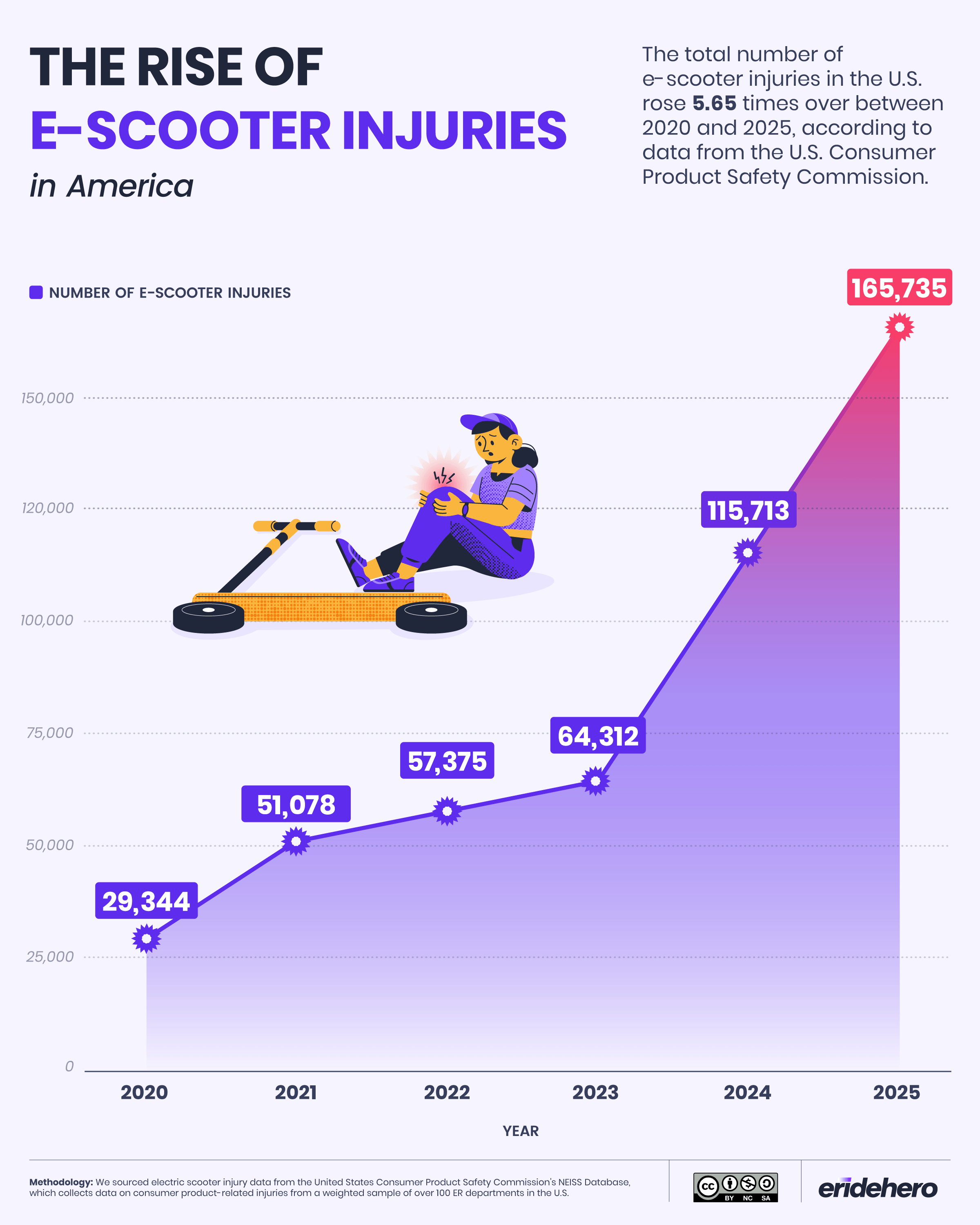
First, we looked at the rise in the total number of U.S. e-scooter injuries over the past five years.
Overall, the figure has risen 5.65 times, from 29,344 in 2020 to 165,735 in 2025. The decade began with a 74% rise in injuries between 2020 and 2021, as ride shares emerged from a COVID-19 slump and the total number of shared micromobility trips since 2010 passed half a billion.
However, while injury numbers rose by 80% from 64,312 to 115,713 between 2023 and 2024, the latest figures show a rise of just 43% between 2024 and 2025.
“Well-designed micromobility programs mean safer, more sustainable and resilient cities,” says Corinne Kisner, Executive Director of the National Association of City Transportation Officials (NACTO). “By redesigning streets, lowering speeds, and prioritizing bikeway projects, local leaders can ensure that the bike and scooter boom continues to gain momentum, connecting people to the opportunities in their cities.”
But recent research suggests that the behavior or riding style of e-scooter riders could be what’s keeping injury levels high among riders and pedestrians alike.
“Just a step or two out the doorway I walk out and just boom. I landed right on my hip, I could hear it and feel, and I thought that’s bad,” pedestrian John Stamstad, victim of a hit-and-run scooter in Seattle, told King 5 News. “There was a bike lane just like, 10 feet out. I don’t think the person was malicious, but he was negligent.”
Children Are Incurring a Higher Proportion of E-Scooter Injuries
Next, we looked at how different age groups are represented in the e-scooter injury statistics. We began by examining the rise in the number of children suffering such injuries.
The number of injuries among under-sixes has risen 1.5 times since 2020, four times among under-11s and nearly eight times among under-15s. The number of preschool children injured by e-scooters fell by 37.4% in 2025, but the number of injuries among 11- to 14-year-olds doubled to 18,207.
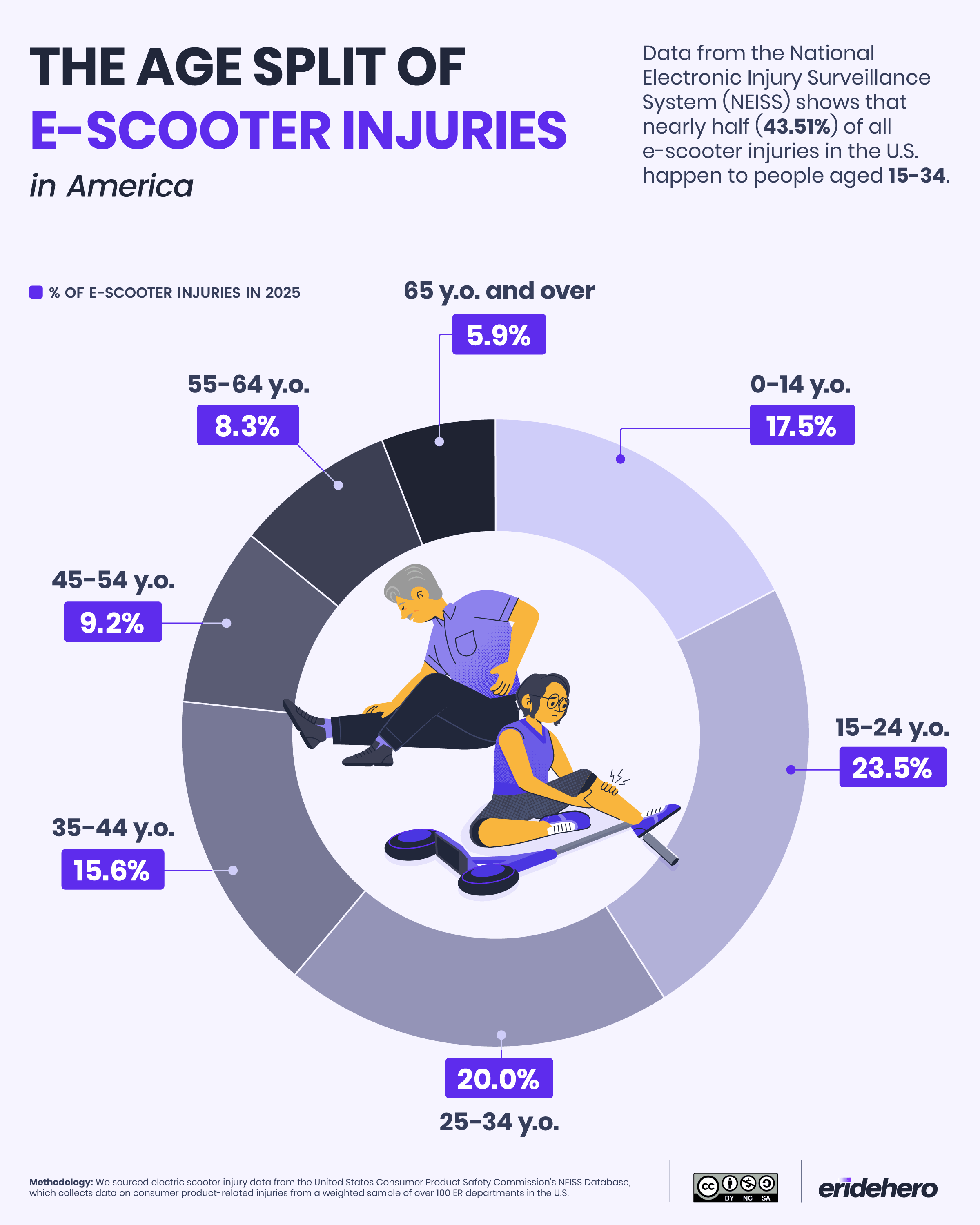
Not only is the number of children injured by e-scooters rising dramatically each year, but the proportion of injuries that happen to under-15s continues to rise, compared to other age groups. In 2025, 17.5% of all U.S. e-scooter injuries happened to those who are 14 or younger, up from 15.3% in 2024 and just 10.7% in 2021.
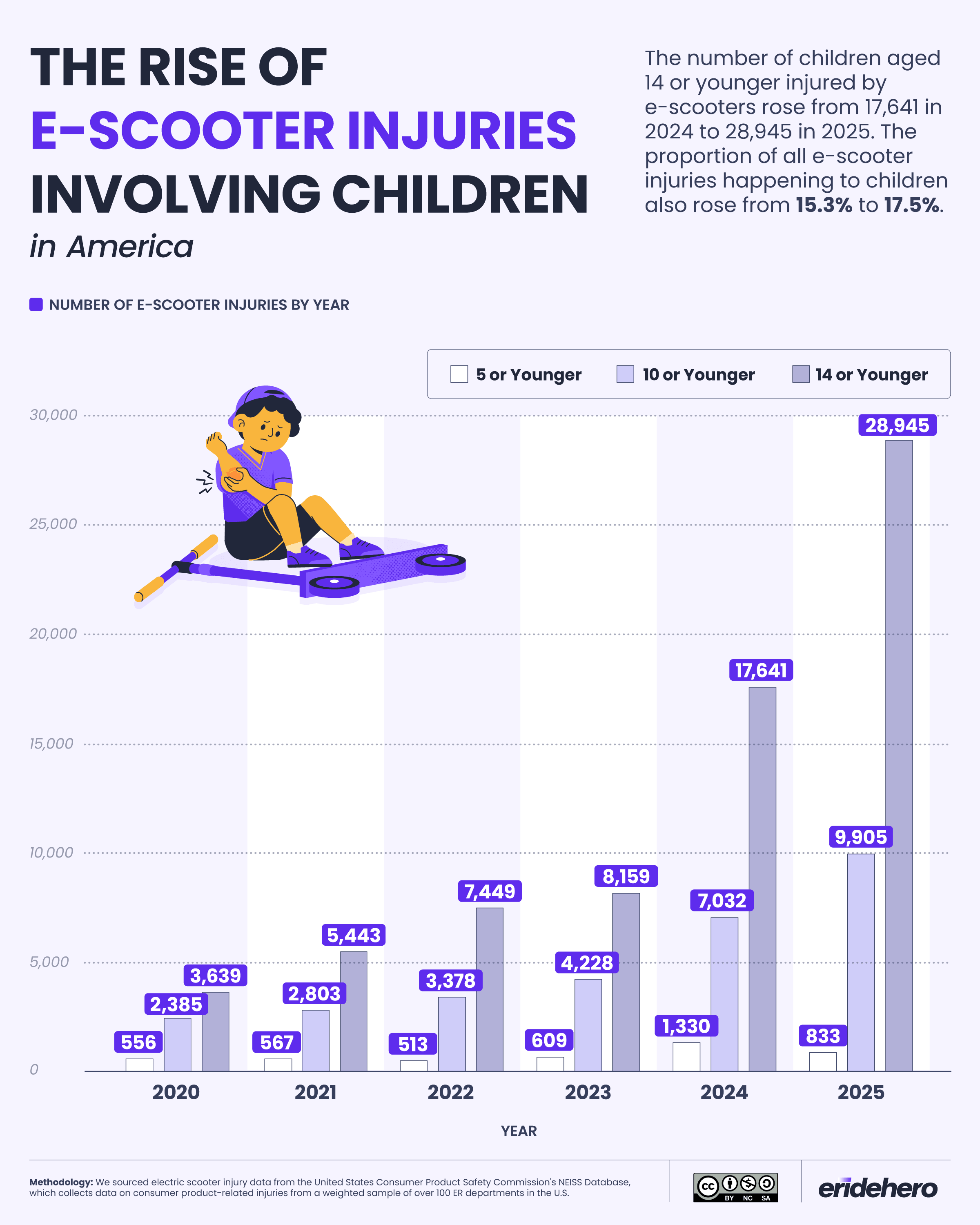
E-scooter injuries are generally weighted towards younger generations, with the 15-24 age group incurring 23.5% of all injuries. Some 61.0% of e-scooter injuries occur to those aged 34 or younger.
The trend of young people being injured by e-scooters may be occurring as the market broadens, e-scooter use becomes “normal” and cheaper or second-hand scooters become appealing gifts from parents to children.
Some parents seem to have bought their kids e-scooters without realizing that they can go from zero to 40 km/h in seconds, says Daniel Rosenfield, a pediatric emergency physician. “From an emotional and cognitive perspective — where you just have the ability to understand where your body is in space, how you can make turns, what’s far ahead and what’s not — [it is] similar to driving a car.”
Electric Scooter Riders Are Statistically Most Likely to Damage Heads
One refrain that repeatedly emerges in e-scooter research is that helmets save lives.
This is underlined by our own analysis, which found that 33,404, or one-fifth, of all e-scooter injuries in 2025 were head injuries — and this doesn’t include injuries to the face and sensory organs. We’ve mapped out the prevalence of injuries to each body part below: the head and joints of the extremities all commonly taking the brunt of a fall.
“Kids need to be in appropriate safety gear,” said pediatric emergency medicine physician Dr. Meghan Martin. “They should be wearing helmets, they should be wearing not flipflops or sandals but full foot sneakers, covered shoes, covered toes. They should also be in long pants, long sleeves, in case they were to crash.”
“With the introduction of e-scooters and e-bikes, we’ve certainly seen different types of injuries than we’ve seen in the past,” said Dr. Graham King, St. Joseph’s Health Care London’s Chief of Surgery at the Roth McFarlane Hand & Upper Limb Centre. “A lot of facial fractures from falling and hitting your face or head.
“They can also be open fractures because the force is so high. These things go up to 30 kilometres per hour or more. When they hit the ground, the bones sometimes come through the skin, and have what we call compound fractures.”
Two-Thirds of Electric Scooter Injuries Are Incurred by Men and Boys
In 2025, just over two-thirds (67.1%) of e-scooter injuries were incurred by males. However, research has shown that while males are more likely to be involved in accidents — in part because they take more e-scooter journeys — females who ride are 1.5 times more likely to be involved in an injury crash.
Nichole Morris, director of the University of Minnesota’s HumanFIRST Laboratory, says that this female susceptibility to e-scooter injuries “may suggest a need to examine potential e-scooter design issues that may not adapt well to female riders, such as handlebar height, center of gravity, and required upper body strength.”
Nearly 15,000 Annual E-scooter Injuries Involve Driving Under the Influence
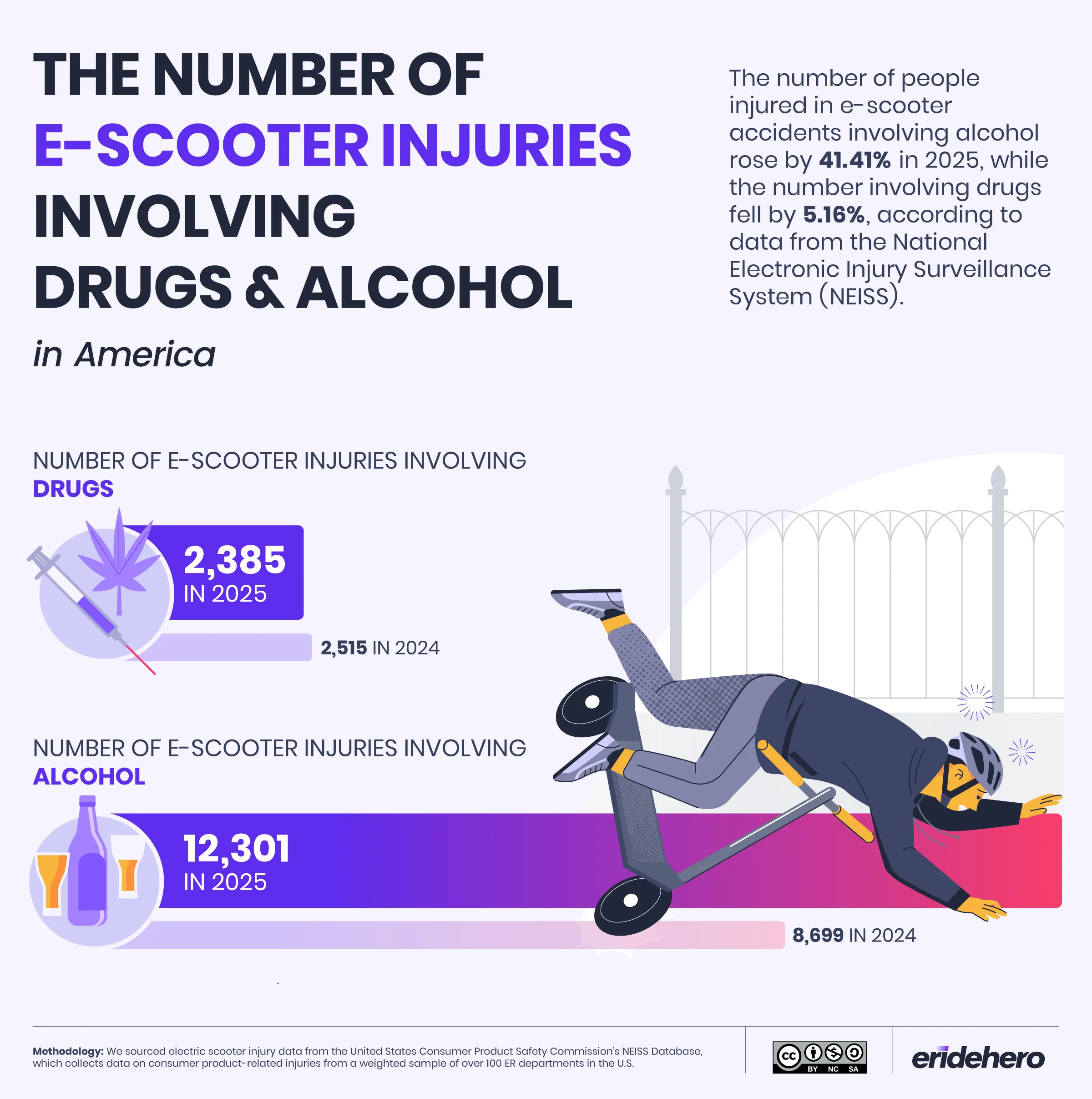
Of 165,735 e-scooter injuries in 2025, some 2,385 (1.4%) involved recreational drugs, and 12,301 (7.4%) involved alcohol. This is a year-on-year fall in the number of drug-related injuries. While alcohol-related injuries have risen by 3,602, this is broadly in proportion to the overall rise in e-scooter injuries.
Worryingly, a study from North Dakota State University found that, “Compared with adults under age 40, children ages 10 to 17… had 7.5 times greater odds of these emergency department visits that involved drinking.”
Research has shown that driving while intoxicated is disproportionately likely to result in a head injury; some 68% of alcohol-related e-scooter injuries result in head trauma, compared to 28% among non-alcohol-related injuries.
Riding an e-scooter under the influence may land you with a DUI in most states, although some — such as Wisconsin — don’t count an e-scooter as a vehicle for DUI purposes.
Summer is Peak Season for Electric Scooter Injuries
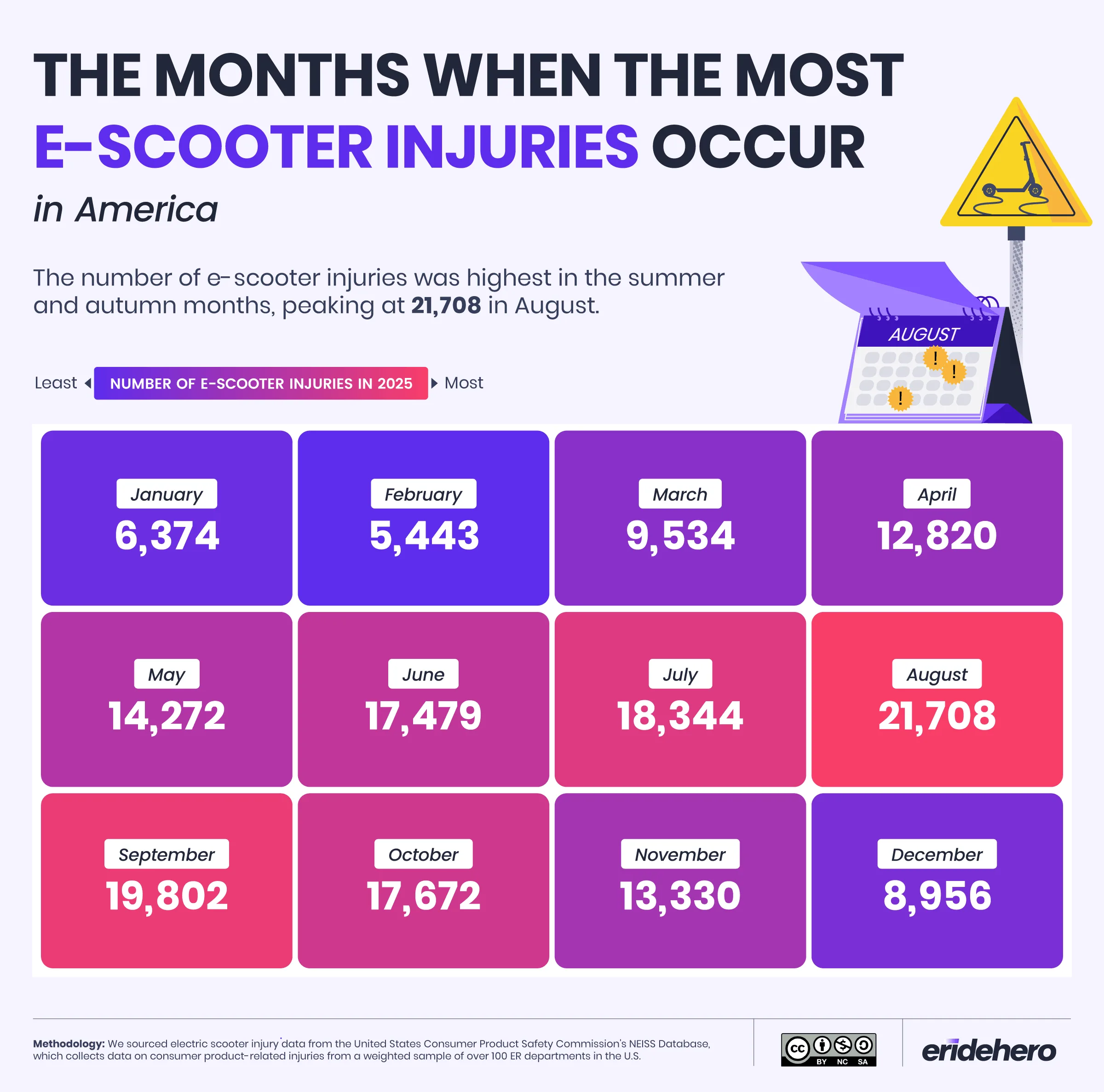
Next, we looked at the timing of e-scooter-related injuries. The danger peaks in the summer, with 21,708 injuries occurring in August 2025. The lowest figures were for the winter months of February (5,443), January (6,374) and December (8,956).
However, research has shown that e-scooter riders experience a greater proportion (24.2%) of all e-scooter injuries during the winter months than bicycle riders (20%).
Weekends are the worst time of the week for e-scooter injuries. Some 26,825, or 16.2%, of all e-scooter injuries in 2025 occurred on a Saturday — almost exactly the same proportion as in 2024. Sunday (25,932 or 15.6%) remains the second most likely day to get hurt.
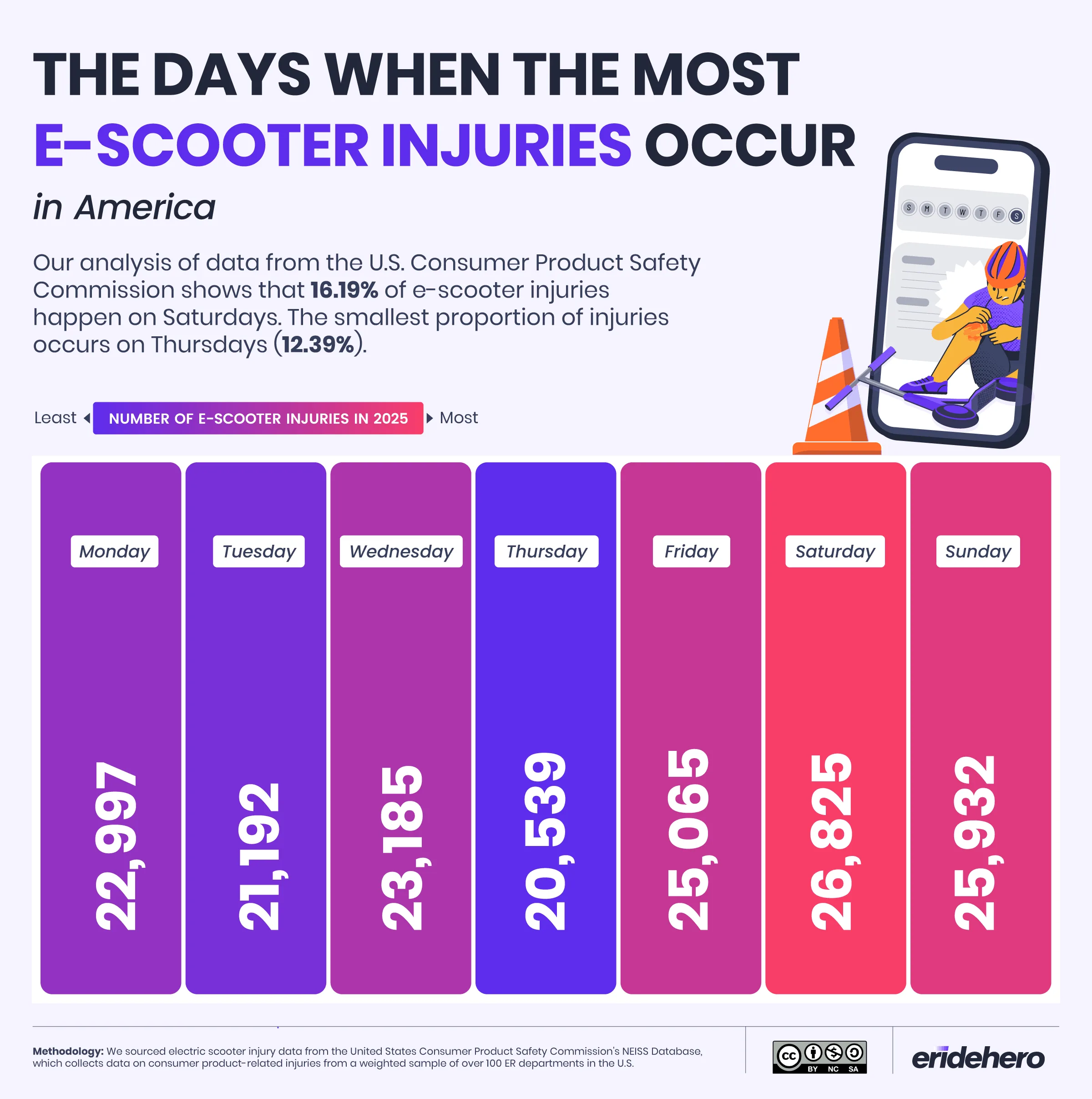
Friday also stands out as a high-impact day. But U.S. e-scooter injuries are far more evenly spread throughout the week and weekend than in other countries. At least two studies in separate German cities found that more than half of local e-scooter injuries occurred on weekends, with one study concluding that this pattern indicates the dangers of leisure-oriented use.
New Zealand Has Densest Cluster of E-Scooter Road Accidents
Finally, we appraised the frequency of electric scooter-related road accidents per capita in every country.
With 3,991 annual e-scooter road accidents among its population of 5.3 million people, New Zealand suffers the highest density of such events: 755 per million people.
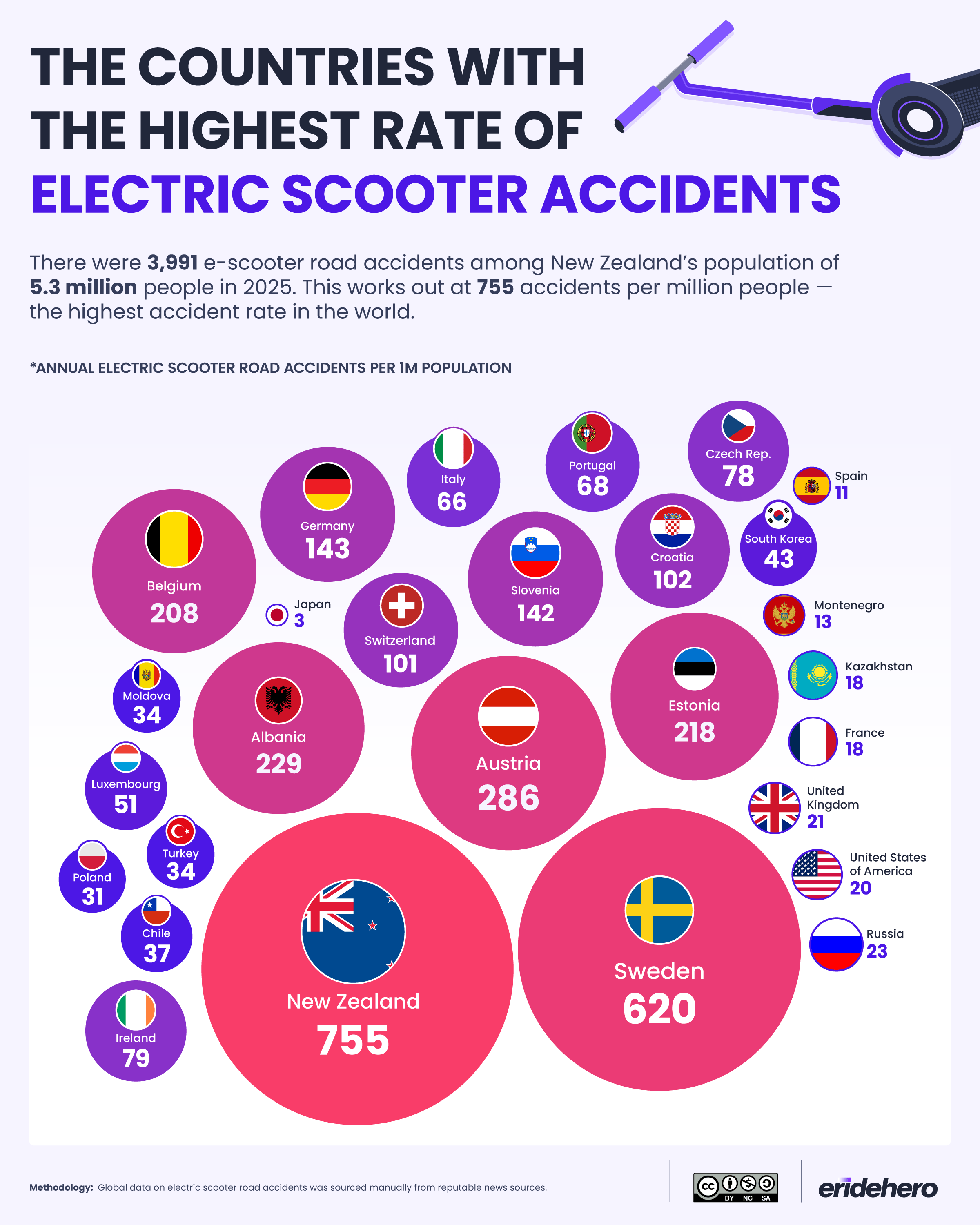
Unlike many other places in the world, in New Zealand it is permitted to ride an e-scooter on the road or on the sidewalk. Evidence is mounting that the prevalence of e-scooters on the streets discourages pedestrians from leaving their homes for fear of getting hurt, with advocacy group Blind Citizens NZ claiming that speed restrictions and other controls are not currently working.
“There’s no question that e-scooters are convenient, fun, and get you places faster,” said engineering firm WSP’s research manager, Louise Malcolm. “But they’re also five times more likely than cycling to cause death or serious injury. That’s why it’s so important we get the safety settings right.”
Micromobility Should Be Convenient, Not Casual
Shared and electric micromobility options like e-scooters can be convenient and fun, improving accessibility and potentially reducing some areas of ecological wear and tear (production and disposal footprints notwithstanding).
However, as the technology has been rolled out — often in a landgrab scenario as brands tried to conquer the market — safety legislation and user sophistication have lagged behind.
For example, it is not currently the norm to wear a helmet or take training before riding an e-scooter. With a slower or more controlled introduction, these cultural patterns might have been shaped very differently.
Research has found that although “reducing the collision speed from 25 km/h to 15 km/h can decrease the risk of head injuries to pedestrians by up to 49 percent,” riders tend to default to the top available speed.
As such, when starting out with electric scooters, riders should take the following precautions (see also our full list of electric scooter safety tips):
- Learn and practice before you ride
- Always wear a helmet
- Stick to the cycle lane and follow road rules
- Slow down and give yourself more time to respond to pedestrians, vehicles and potholes
- Never ride under the influence — it endangers you and others around you
- Keep both hands on the handlebars
The streets are a communal space, and the way you ride influences both the safety of others and the example you set for new electric scooter riders.
Our Methodology
We sourced electric scooter injury data from the United States Consumer Product Safety Commission’s NEISS Database, which collects data on consumer product-related injuries from a sample of more than 100 ER departments across the U.S. The database provides weighted scores for each injury entry, enabling us to extrapolate the figures to represent estimates for the entire U.S. We also sourced the global data on electric scooter road accidents manually from reputable local news sources.
This data analysis was completed in July 2026.