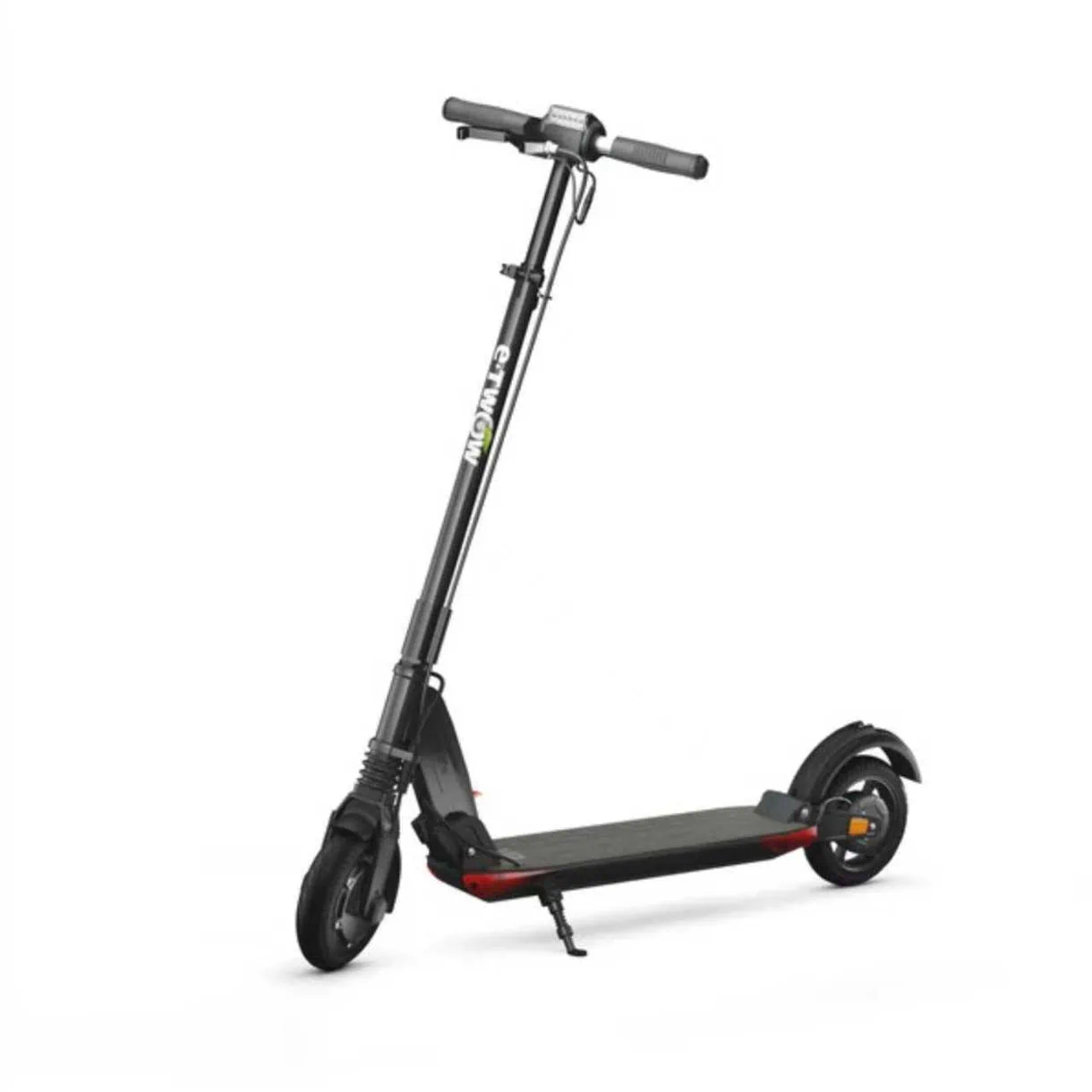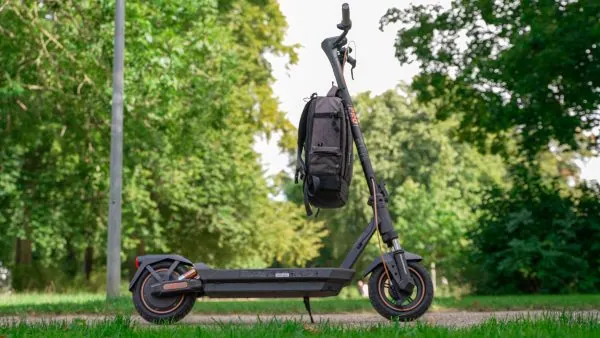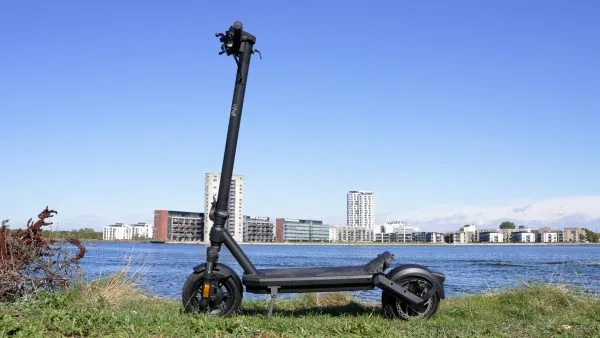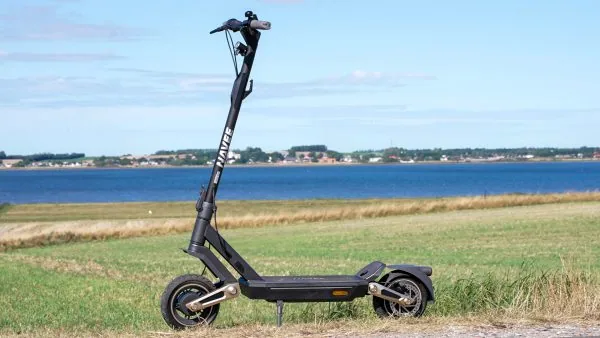
Our review score is based on thorough real-world testing and is always held up against comparable models.
How We TestValues marked with '*' are based on our independent testing and may differ from those specified by the manufacturer.

The 200F delivers solid performance for an affordable, nimble commuter. It's a meaningful step up from the 100F and KQi2 Pro for moderate hills, though it's still not built for steep grades.
I clocked a top speed of 19.3 MPH in testing as a 175 lbs (80 kg) rider.
| Model | Top Speed | Motor (Peak) |
|---|---|---|
| NIU KQi 200F | 19.3 MPH | 350W (700W) |
| Segway E3 Pro | 19.3 MPH | 400W (800W) |
| NIU KQi 100F | 17.4 MPH | 300W (600W) |
| NIU KQi2 Pro | 17.3 MPH | 300W (600W) |
The 200F matches the E3 Pro and gives you about 2 MPH more than the NIU KQi 100F. It's not a huge performance jump, but it does mean getting from A to B a bit faster.
The 200F accelerates smoothly without feeling aggressive. Across 10 test runs, I averaged 0-15 MPH in 7.32 seconds.
| Model | 0-15 MPH (avg) |
|---|---|
| NIU KQi 100F | 7.2 s |
| NIU KQi 200F | 7.32 s |
| Segway E3 Pro | 7.85 s |
| NIU KQi2 Pro | 8.83 s |
The acceleration feels quite similar to the 100F despite the more powerful motor, so NIU likely tuned them similarly. You do get a bit more pull when starting on grades, but it's not a huge difference.
Since the 200F runs on a 48V system, it maintains performance (speed, acceleration, hill climbing) much better than 36V alternatives like the Segway E3 Pro. Personally, 36V batteries are always gonna be a dealbreaker because even 20-MPH scooters start to feel sluggish below 50% charge.
The 200F handles moderate hills confidently. On my standard 250-foot test hill at an 8% grade:
| Model | Time | Avg Speed |
|---|---|---|
| NIU KQi 200F | 24.7 s | 6.9 MPH |
| Segway E3 Pro | 24.8 s | 6.9 MPH |
| NIU KQi 100F | 28.5 s | 6 MPH |
| NIU KQi2 Pro | 30.48 s | 5.6 MPH |
The 200F performs essentially identically to the E3 Pro and climbs noticeably faster than both the 100F and KQi2 Pro. It can handle grades in the 10-12% range without issue.
Touching on the 48V setup again, the 200F climbs consistently even on low battery, whereas the E3 Pro started to lose its ability quite quickly.
For riders under 220 lbs dealing with occasional moderate hills, the 200F works well. If you're regularly tackling steep hills of 12% or more, consider the NIU KQi 300X or 300P instead.
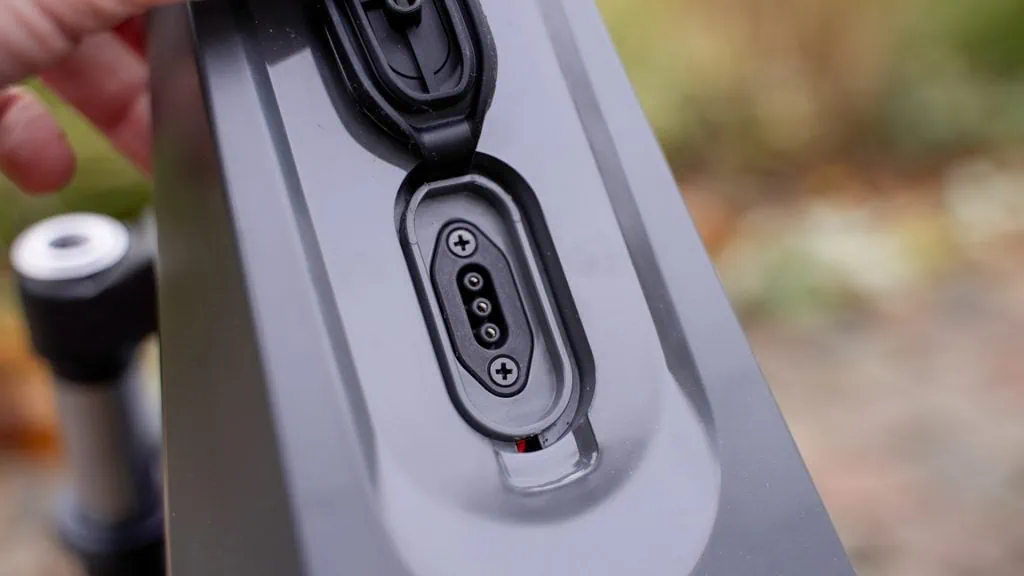
The 200F delivers 18.5 miles of real-world range, which is a big upgrade over the 100F and more than enough for most urban commuters. It's not a long-range champion, but it gets the job done for typical daily use.
I conducted three standardized range tests at different speeds to see how the 200F performs in the real world.
| Test (#) | Range | Avg. Speed |
|---|---|---|
| #1: Speed Priority | 15.3 miles 24.6 km | 17.2 MPH 27.7 KMH |
| #2: Regular | 18.5 miles 29.8 km | 14.7 MPH 23.7 KMH |
| #3: Range Priority | 21.2 miles 34.1 km | 12.5 MPH 20.1 KMH |
Here's how the 200F stacks up against other compact commuters (based on the #2 regular range test results).
| Model | Regular Range | Battery |
|---|---|---|
| NIU KQi2 Pro | 19.8 miles | 365Wh |
| NIU KQi 200F | 18.5 miles | 365Wh |
| Segway E3 Pro | 17.2 miles | 368Wh |
| NIU KQi 100F | 11.38 miles | 243Wh |
The 200F delivers 63% more range than the 100F. It almost matches the KQi2 Pro despite having the same battery, which makes sense given the slightly more powerful motor. The E3 Pro falls behind despite having a nearly identical battery capacity, likely due to its less efficient 36V system.
For a typical 5-7 mile commute, you're looking at charging every 2-3 days. Anything over 15 miles round trip, and you'll need to charge daily or look at higher-capacity options like the Navee GT3 Pro. For its weight and size, the 200F is hard to beat range-wise.
Charging takes 6-7 hours from empty, which is standard for this battery size. The app includes a charge limiter that lets you cap charging to extend battery lifespan. With a relatively small 365Wh battery, most riders will probably charge to 100% for maximum range, but having the option to preserve battery health for daily commutes is both nice and rare.
The 200F is a very comfortable ride for its size and weight. The combination of front suspension and larger tubeless tires handles varied terrain better than you'd expect from such a compact scooter.

The front spring suspension is essentially the same setup as the 100F, though it's tuned slightly stiffer. I don't mind this; it means riders approaching the weight limit won't bottom out. It's still responsive and engages smoothly without feeling jumpy or unstable.
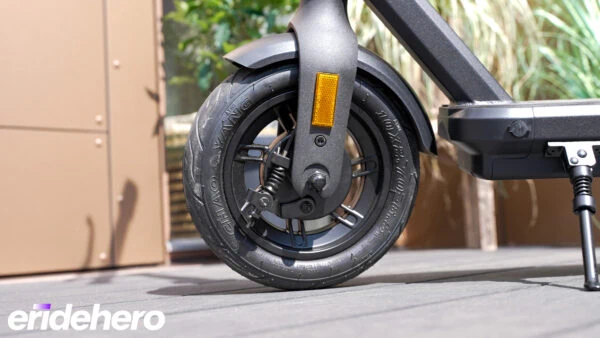
The 200F uses 10" x 2.3" tubeless tires as opposed to the 100F's 9.5" tubed tires. The extra 0.5 inch is subtle, but you feel it on rough roads. More importantly, tubeless means lower maintenance over time. No pinch flats, and you can add tire sealant for extra puncture protection.
I tested the 200F on everything from smooth roads to hard-packed trails and cobblestone. The suspension and tires made it a much more enjoyable experience than riding the KQi2 Pro on those same surfaces.
I also tested it on wet roads full of fall leaves. It felt super grippy, which is one of the main benefits of the larger tires.
Overall, I'd rate the ride quality equal to the 100F, maybe even 5% better, thanks to the slightly larger tires. It won't match the Navee GT3 Pro's dual suspension, but that scooter is much bulkier. It doesn't get much better than the 200F in this weight/size class.
The drum brake, paired with regenerative braking, delivered a 15.6-foot stopping distance from 15 MPH in my tests. That's adequate for a scooter with a top speed of 19.3 MPH.
| Model | Braking Distance |
|---|---|
| NIU KQi 100F | 12.8 ft (3.9 m) |
| NIU KQi2 Pro | 14.6 ft (4.5 m) |
| NIU KQi 200F | 15.6 ft (4.8 m) |
| Segway E3 Pro | 16.5 ft (5 m) |
The 100F and KQi2 Pro both had a shorter stopping distance in my tests. It's still perfectly fine for a low-speed scooter like this - it also outperformed the Segway E3 Pro.
I like that NIU went with a drum brake. Their longevity and maintenance requirements are much better than discs, and they also perform better in the rain. You can adjust the regenerative braking strength from 1-3 (or turn it off) via the app. It's smooth and predictable and integrates seamlessly with the physical drum brake.
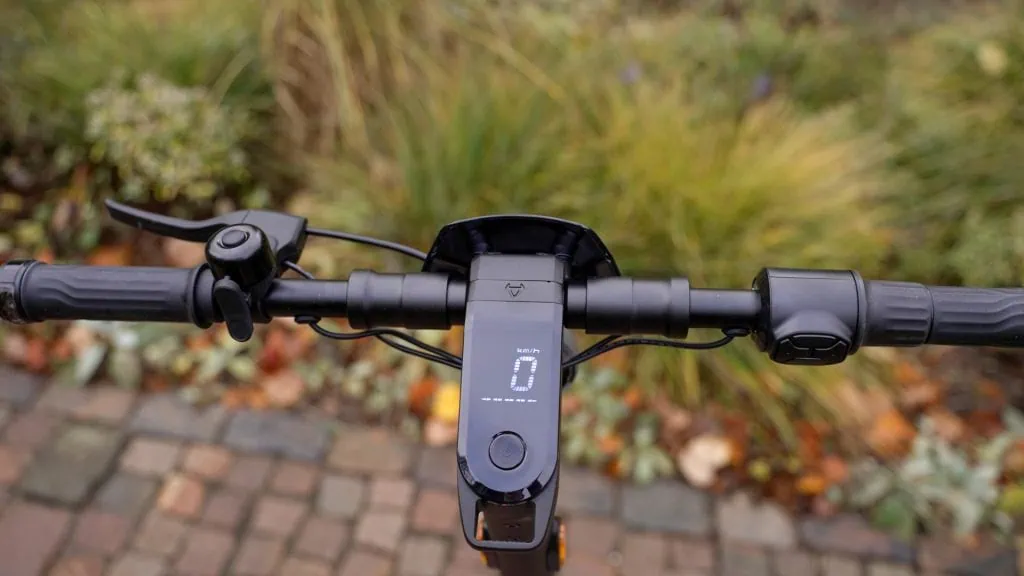
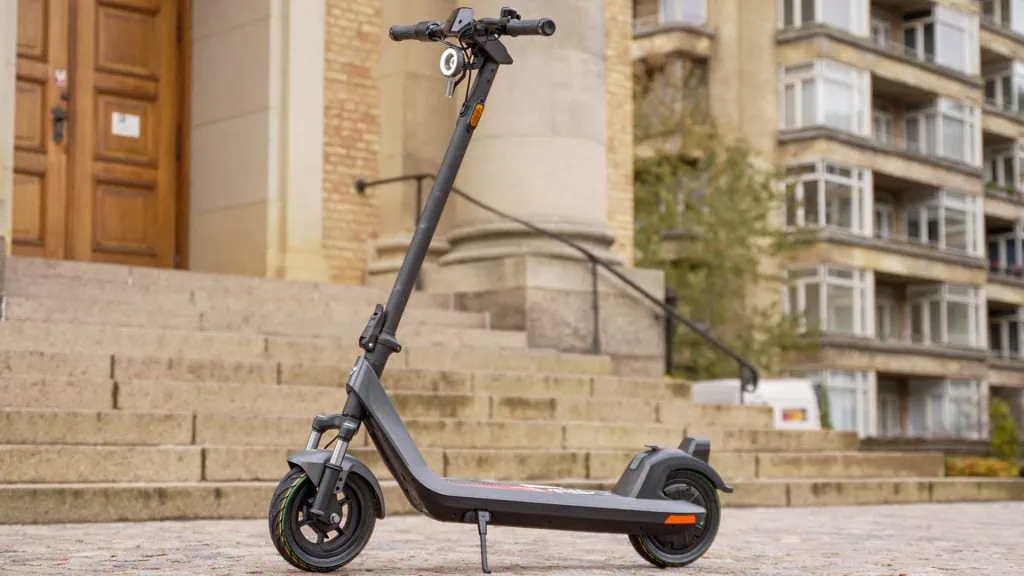
The 200F uses a large, centered display—the same one as the KQi2 Pro. It's cleaner and easier to read than the 100F's display, though it's not super bright in direct sunlight.
My only gripe is the power button below the display. It barely provides any tactile feedback, so I was not always sure whether I pressed it. Sometimes it took a few presses. It's a minor non-issue as you'll rarely use it, but it's worth noting.
The wide 23.9" handlebars provide good control and comfortable grips.
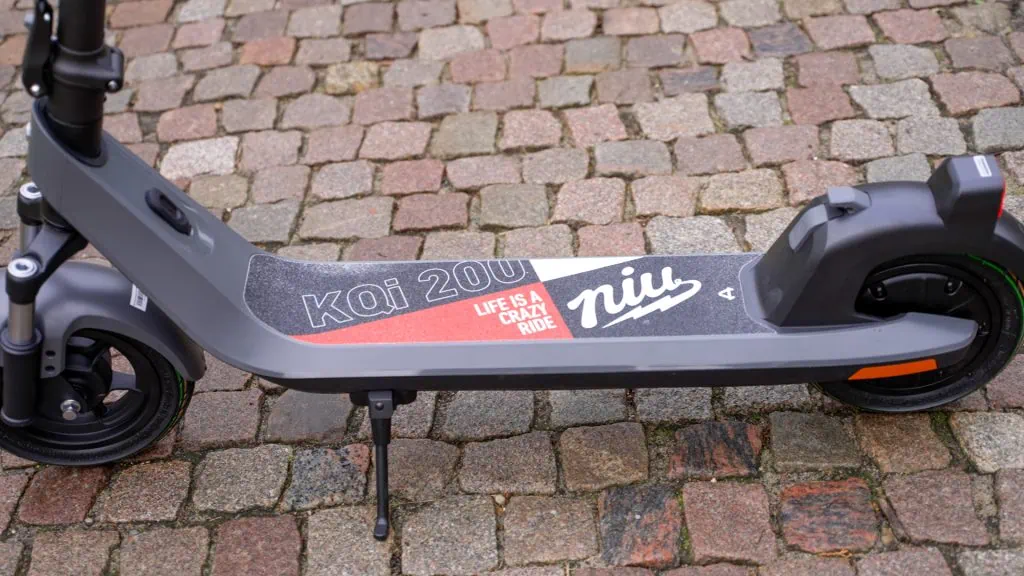
The deck measures 18.9" x 5.3", so it's relatively slim, but there's enough length to shift your footing around comfortably. NIU has kept the signature grip tape from the KQi2 Pro, which makes a lot of sense. It's the most grippy surface you'll find on any e-scooter, which is great in wet conditions.

You've got turn signals integrated into the handlebars. They blink until you turn them off, which is more practical than auto-canceling signals. I'm happy to see NIU among the frontrunners in integrating turn signals into every new scooter release, as they significantly improve safety in traffic.
The lighting setup is standard NIU quality. You get a really bright, always-on halo front light. The taillight is larger than average and brightens when the brakes are applied. NIU has also been generous with reflectors. Combined with the turn signals, the 200F has you covered for urban riding day and night.

At 44.1 lbs, the 200F isn't the lightest commuter scooter, but those extra pounds buy you meaningful upgrades over its competitors.
| Model | Weight (lbs) | Weight (kg) | Foldable Handlebars |
|---|---|---|---|
| NIU KQi 100F | 38.8 lbs | 17.6 kg | Yes |
| Segway E3 Pro | 40.1 lbs | 18.2 kg | No |
| NIU KQi2 Pro | 40.6 lbs | 18.4 kg | No |
| NIU KQi 200F | 44.1 lbs | 20 kg | Yes |
The 200F is about 4 pounds heavier than the E3 Pro. But those extra pounds get you front suspension, larger tires, foldable handlebars, and a 48V system.
The weight distribution is well-balanced. At 175 lbs myself, I find it manageable for stairs and short carries. It's not featherlight, but it's perfectly reasonable for daily commuting needs.

NIU continues to make some of the best folding mechanisms in this price range. The 200F uses the same proven design as the KQi2 Pro. It's smooth to use, has a safety pin to prevent accidental opening, and has a secure hook to the rear fender. After extensive testing, there's no loosening or wear.
The foldable handlebars are what really set the 200F apart from the KQi2 Pro and E3 Pro. They're rock-solid with no wobble, easy to fold, and make the scooter genuinely compact when stored.
With both the stem and handlebars folded, the 200F becomes much easier to store under a desk, fit in a car trunk, or integrate with public transport. The folded dimensions (6.9" wide, 21.5" tall, 45.3" deep) make it one of the most practical options for mixed-mode commuting.
If you absolutely need the lightest option and already have foldable handlebars, the 100F saves you 5 pounds. But if you want more range and performance, while still keeping that compact folded size, the 200F delivers.
If you've got extra money to spend, the NIU KQi Air is exceptionally light (26.4 lbs), but it doesn't have suspension or foldable handlebars.
The 200F builds on the proven KQi2 Pro chassis, which has an excellent reliability track record. NIU has very few structural failures compared to how many units are out there, and that reputation holds true with the 200F.
The frame is solid with no flex or creaking. NIU kept what worked from the KQi2 Pro and added quality-of-life improvements where it made sense.

The fenders are reinforced with multiple contact points, so they stay put without rattling or rubbing. The deck has a grip tape surface, which keeps your feet strongly in place even in the rain.

I stress-tested the folding mechanism (200 cycles) and kickstand (500 cycles) with no issues. Nothing has loosened or needed retightening. This is just a testament to the typical quality NIU puts out. They build scooters that hold up over time.
The 200F has a respectable IPX5 weather resistance rating. I've ridden it in the rain several times with no issues. I've had no electronic issues, and the 10" tires have been a bliss on wet surfaces. They feel really grippy and hold air very well.
Just avoid deep puddles and dry your scooter off after wet rides to prevent long-term corrosion.

In my opinion, NIU and Segway have the best apps in the e-scooter industry. The offer more features and customizations than most and I've had very few software-related issues across all NIU models I've tested.
In the NIU app, you can customize the following for the KQi 200F:
The only downside with the NIU ecosystem is that you're forced to use the app to make changes. This is becoming an industry standard, and I personally don't mind it, but some riders prefer having everything accessible on the scooter display.
NIU offers a 2-year warranty, which is excellent for this price range. The only downside is that NIU operates as a closed system, so you can't easily source parts for DIY repairs. Most riders won't mind, but it's worth knowing if you prefer to maintain your own scooter.

The NIU KQi 200F is a strong upgrade with a proven foundation. It's perfect if you need a versatile scooter for 15-mile round trips that's both comfortable and compact. It's low-maintenance, ticks all the boxes for all-weather use, and delivers consistent performance thanks to its 48V battery. It's powerful enough for moderate hills (10-12%) but isn't for steep grades.