
We earn commissions from links on our site, enabling us to deliver independent reviews. See our editorial policy.
Quick take
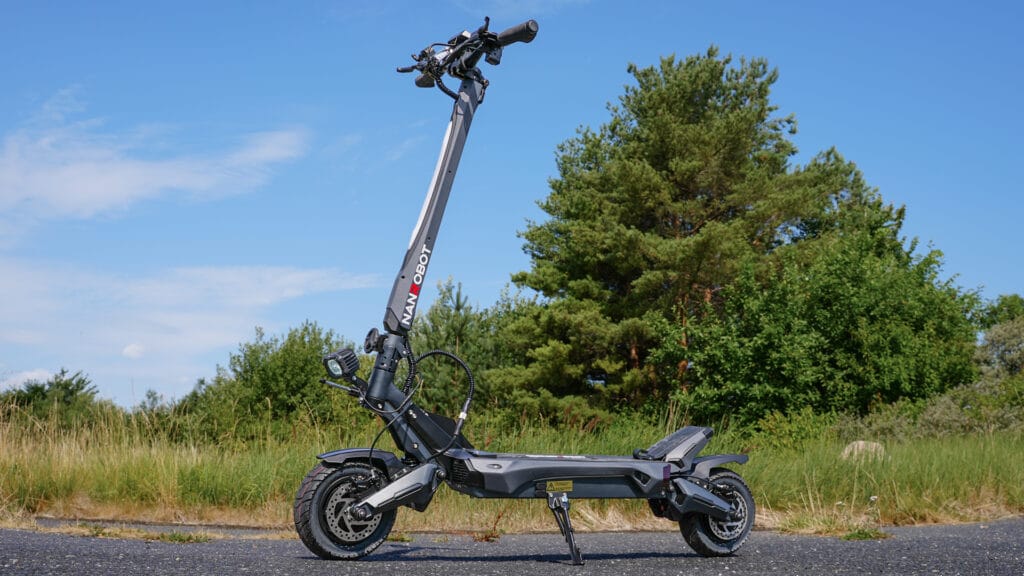
The Nanrobot N6 72V is pretty much the most performance you can buy at its price. A true 72V system with a 2,160Wh Samsung battery, a tested 49.8 mph and 49.6 miles of real range, plus solid mid-tier NUTT brakes and adjustable KKE suspension. The quirks are minor and don't take away from the value.
What I like
- True 72V system with 2,160Wh Samsung 21700 battery
- Excellent performance per dollar
- Impressive 49.6 miles tested range
- Plush, fully adjustable KKE suspension
- Nutt hydraulic brakes stop in just 10.6 ft (from 15 MPH)
- Quick-release motors make tire change easy
What I don't like
- Tubed tires at these speeds (add sealant day one)
- Deck mat edges peel over time
- Headlight blocks the folding mechanism
- Slow charging - 8 hours even with dual chargers
Where to buy
 Nanrobot N6 72V

Tested performance
- Top speed
- 49.8 mph
- Range
- Range priority
- 57.7 mi
- Regular
- 49.6 mi
- Speed priority
- 40.4 mi
- Acceleration
- 0–15 mph
- 2.38 sec
- 0–20 mph
- 3.79 sec
- 0–25 mph
- 5.71 sec
- 0–30 mph
- 7.72 sec
- Braking
- 10.6 ft
I’ve put over 500 miles on the N6 72V, split between smooth city roads and rougher off-road stretches. Every performance figure in this review is measured with precision using a Racelogic VBOX Sport. Apart from putting it through all kinds of ride conditions, I’ve benchmarked its top speed, acceleration, braking and range. Here’s how it holds up.
Motor & Speed
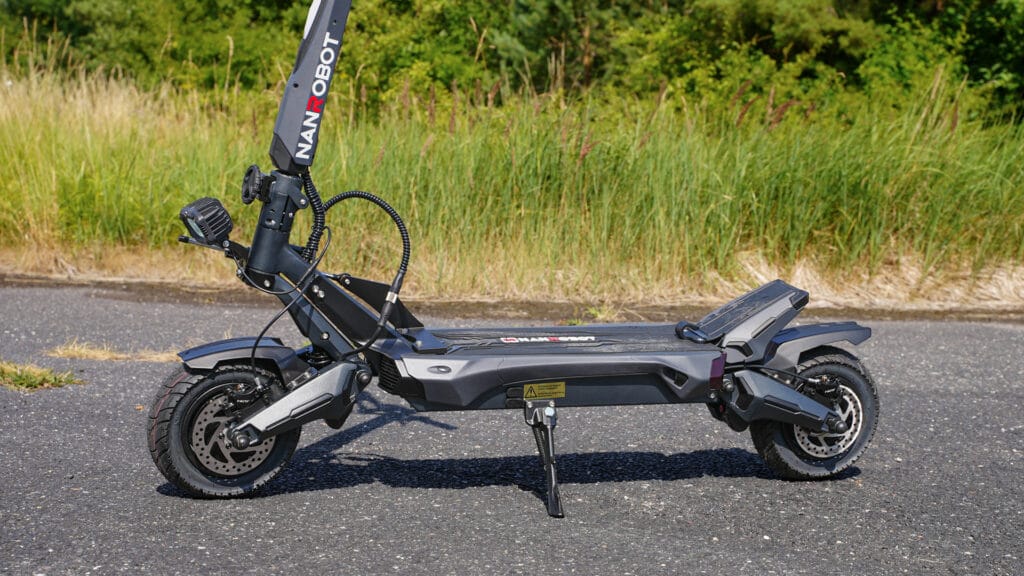
The N6 72V runs two of Nanrobot’s own 1,500W hub motors, which combine for 3,000W nominal and 5,000W at peak through sine-wave controllers. That’s a lot of motor for the money, and on the road it’s honestly more than most riders will ever need.
Worth knowing before the numbers: you’re not locked into full power. A long-press on the power button toggles between single motor, dual motor and zero-start, and the P-settings let you cap the top speed anywhere from 10 to 100%. Handy if you need to keep it legal where you ride, or hand it to someone less experienced.
Top Speed Test
As a 175 lbs rider, I clocked a top speed of 49.8 mph on the VBOX. For a scooter under 100 lbs, that’s about as fast as it gets. Only a very few models beat it, and just by a couple of mph.
| Item | lbs | Tested Top Speed |
|---|---|---|
| Nanrobot N6 72V | 92.6 | 49.8 |
| VSETT 10+ (25.6Ah) | 79 | 45.1 |
| Kugoo Kukirin G4 | 81.5 | 42.6 |
| Apollo Phantom V4 | 77 | 41.2 |
| Hiley Tiger T10 Pro 60V | 74 | 38.7 |
| Inokim OxO | 74 | 36.5 |
| ZERO 10X (52V, 18.2Ah) | 80 | 36 |
| Ausom Gosoul 2 Pro | 70.5 | 35.5 |
| Emove Cruiser V2 | 74 | 32.2 |
| Punk Rider Pro | 69 | 31.5 |
| ZERO 8X | 72 | 31.4 |
| Segway GT3 | 87.1 | 31.3 |

Acceleration Test
The acceleration is the strongest I’ve tested at this price point. The N6 pulls from a dead stop with zero throttle delay, and the power delivery is pretty easy to modulate. It comes on smooth rather than jerky, so you can hold exactly the pace you want, and it never feels like it’s trying to buck you off. Lighter riders can actually spin the front tire flooring it in dual motor mode, so lean forward on hard launches until you know the scooter.
| Item | Average (s) | Fastest run (s) |
|---|---|---|
| 0–15 mph | 2.38 | 2.29 |
| 0–20 mph | 3.79 | 3.63 |
| 0–25 mph | 5.71 | 5.48 |
| 0–30 mph | 7.72 | 7.41 |
| 0–49.8 mph (top) | 19.6 | 18.2 |
The three speed modes are tuned further apart than most. Mode 1 is chill and fine for learning the scooter, mode 2 is borderline violent, and mode 3 is full power. If none of them fit how you ride, you can dial the acceleration strength in the P-settings.
Hill Climbing
The N6 flattens everything I’ve pointed it at. Nanrobot claims a 30° incline rating, and while I can’t verify that exact number, the steepest hill I test on here in Denmark is about 17%, and the N6 climbs it without shedding any speed. A dual motor 72V setup like this is always gonna absolutely smash it on hills, and the N6 is no exception.
Another benefit of the 72V setup is that the performance stays consistent and strong deep into the battery. Even down to 10% charge, I was still accelerating strongly and hitting 44 MPH. Lower voltage scooters don’t have the same performance headroom at these speeds, so that’s a true differentiator for the Nanrobot N6.
We test every ride
Independent reviews, buying advice and the real test data behind them. Straight to your inbox.
Join 2,000+ riders


Range & Battery
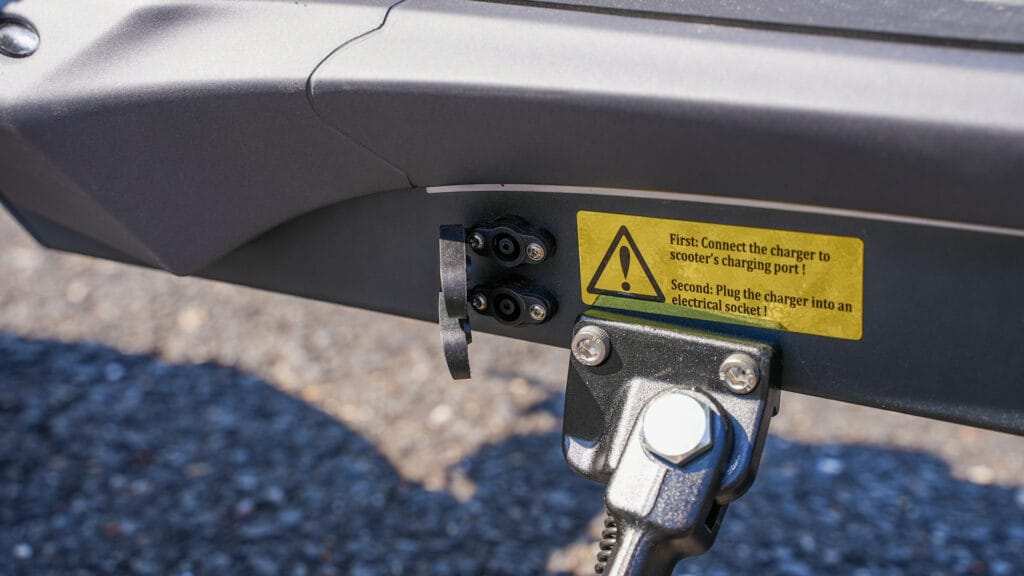
The N6 72V runs a 72V 30Ah battery built with Samsung 50S 21700 cells, 2,160Wh in total. That’s the biggest battery in any scooter under 100 lbs, and it’s the single biggest reason this scooter is such a good deal.
| Item | lbs | Battery Capacity |
|---|---|---|
| Nanrobot N6 72V | 92.6 | 2160 |
| RoadRunner RS6 Ultra | 98 | 2100 |
| Dualtron Victor Luxury + 2.0 | 82 | 1890 |
| Dualtron Thunder | 96 | 2070 |
| Inmotion RS Jet | 90 | 1800 |
| Zsnake Z36 | 89 | 1800 |
| Dualtron Compact (Gen 2) | 70 | 1800 |
| Yume Hawk Pro, 30Ah | 95 | 1800 |
| RoadRunner RS5 Max | 88 | 1664 |
| Kaabo Warrior X Max | 97 | 1620 |
| Varla Eagle One Pro | 90 | 1620 |
| Yume X11+, 27Ah | 98 | 1560 |
| Emove Cruiser V2 | 74 | 1560 |
| Teverun Fighter Mini Pro | 77 | 1500 |
| Dualtron City 2.0 | 91 | 1500 |
| Kaabo Mantis King GT | 74 | 1440 |
| Yume Hawk | 77 | 1350 |
| Navee UT5 Ultra X | 90.4 | 1284 |
| Ausom F1 Max | 79.4 | 1248 |
| E-TWOW TankTorq TK5 | 76.1 | 1260 |
Range Tests
Like any other scooter, claimed range is optimistic. Nanrobot claims up to 81 miles on a charge, but that comes from a lab-style test with a single motor, a 165 lbs rider, and a constant 15.5 mph on flat ground.
As always, I run three range tests at different speeds to see how it performs in the real world. Everything is GPS-logged from full battery to cutoff.
| Item | mi | Avg speed (mph) |
|---|---|---|
| Slow pace | 57.7 | 16.1 |
| Regular pace | 49.6 | 21.9 |
| Fast pace | 40.4 | 28.4 |
These are super strong numbers. Nearly 50 real miles at a moderate cruising speed puts the N6 among the longest-running scooters we’ve tested. And the ones that beat it are almost always heavier. Even when riding hard, it covers 40 miles, which is a week of commuting for a lot of people.
Charging
Despite having dual charging ports, the Nanrobot N6 72V still takes 12 hours to charge with a single charger and 8 hours with two. With a 2,160Wh pack, it was never gonna be quick, but a higher-amp stock charger would’ve been nice (even if it had to be bought as an add-on).
Ride Quality
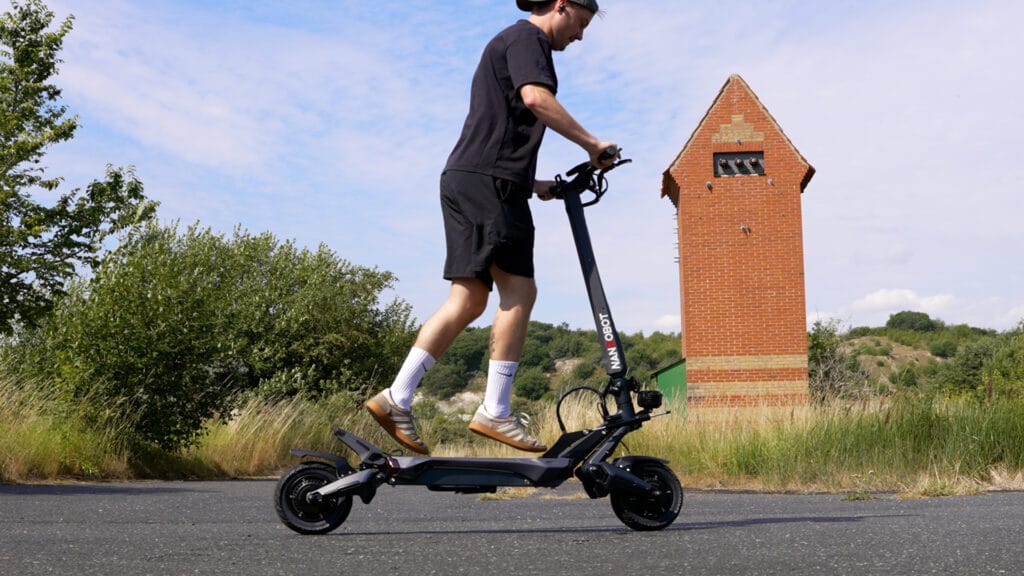
For the price, the N6 rides really well. The setup (KKE suspension, NUTT hydraulic brakes and a steering damper) is the same mid-tier hardware you’ll find on Kukirin, Inokim and Kaabo models, and it’s some of the best bang for buck in the class.
Suspension
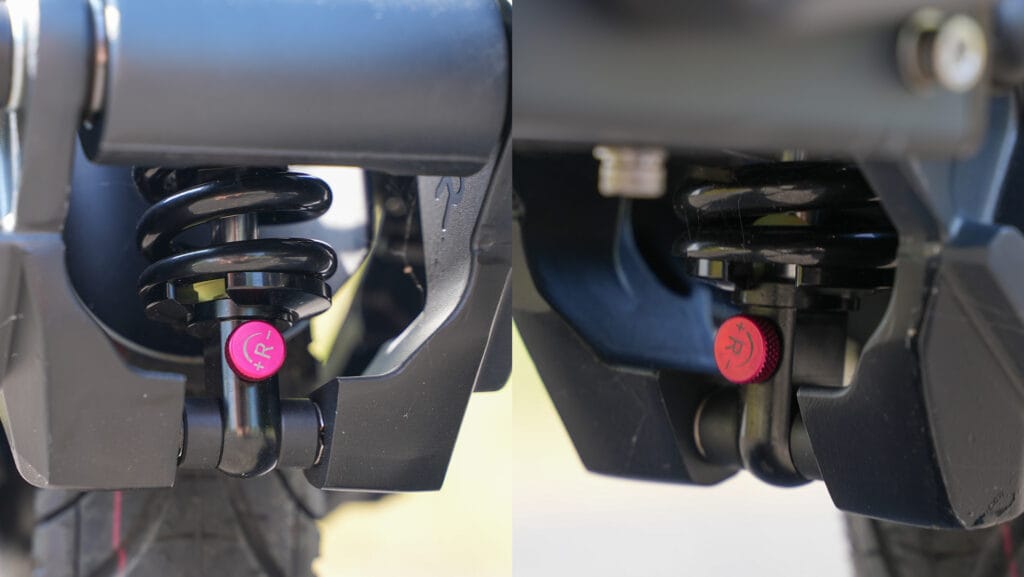
The N6 runs adjustable KKE BA-27 suspension, a 150mm shock up front and 180mm in the rear. It’s plush out of the box, and the preload collars let you dial it in across a wide range.
That adjustability matters more than it sounds. A lot of scooters in this class are too stiff for lighter riders, but this one can be made really soft and bouncy, while riders over 250 lbs can stiffen it enough to stop it from bottoming out.
You also get a steering damper. You can tighten it up for extra high-speed stability and loosen or even take it off entirely if you want the steering as lively as possible. This makes it a very versatile ride.
Brakes
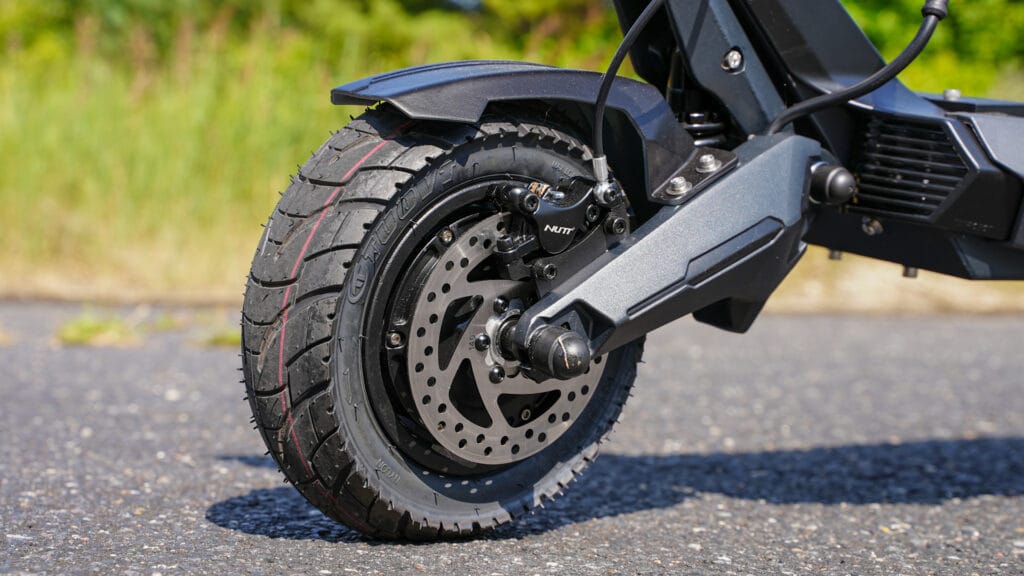
The N6 features dual NUTT A5-D hydraulic disc brakes with adjustable regen (EBS) on top. I measured a 10.6-ft stopping distance at 15 MPH.
In practice, the N6 stops on a dime, with a strong initial bite, good lever feel, and modularity. If the levers start to feel spongy after a few months, a quick bleed brings the sharpness back.
The rotors are 140mm, which perform alright, but I would’ve preferred 160mm rotors for a 50 MPH scooter since they handle heat better and wear slower. But the stopping power was never an issue in my testing.
I found the regen a bit noisy, though it kicks in smoothly. You can adjust its strength in the P-settings. Swapping brake pads is simple, too, since they’re held in place by a pin you can quickly pull out.
Tires & Handling
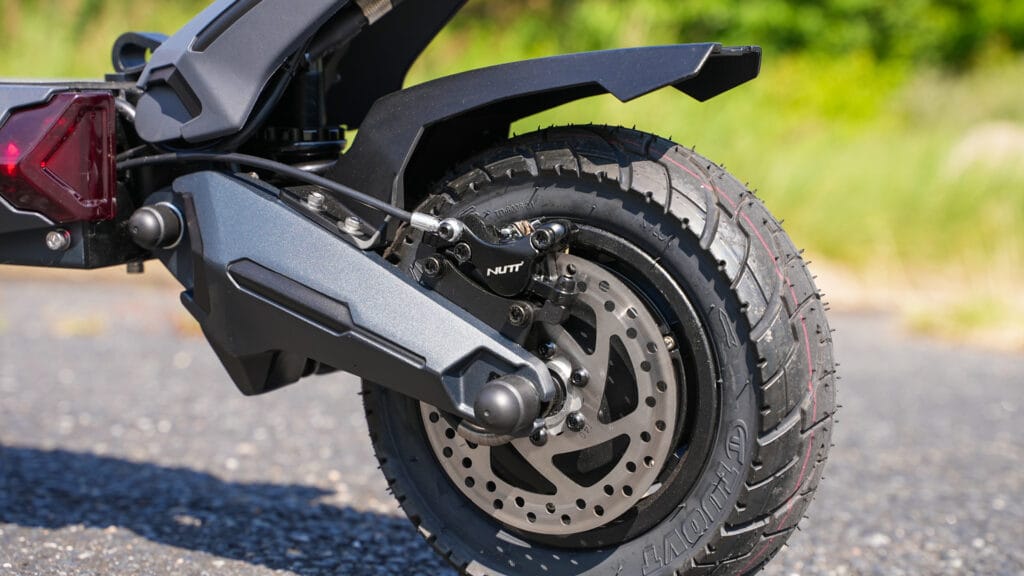
The N6 rolls on tubed 10-inch TOUVT pneumatic tires. Their profile is slightly squared off, which makes the scooter very stable at speed but a bit clunky when you push it hard in corners. They have enough tread for some loose trail patches, too.
The upside is they last a long time. My advice: run the stock set until they’re worn, then upgrade to PMT 10x3s if you want sharper cornering. And since these are tubed tires on a 50 mph scooter, add tube sealant on day one.
Ride height is a bit taller than average, at 6.1 inches of ground clearance. It makes the handling feel more alive, and off-road you’re way less likely to smack the deck on rocks and curbs. If that liveliness isn’t for you, tighten the damper.
Build & Folding
At 92.6 lbs, the N6 is obviously not a light scooter. But considering it’s the fastest sub-100 lbs scooter we’ve tested (with the biggest battery, too), the weight is easy to live with.
It’s also wide for the class, with 24.7-inch handlebars and a 22 x 8.3-inch deck. That width gives you room to move your feet around, and it’s rated for riders up to 330 lbs, more than most performance scooters.
Folding & Portability
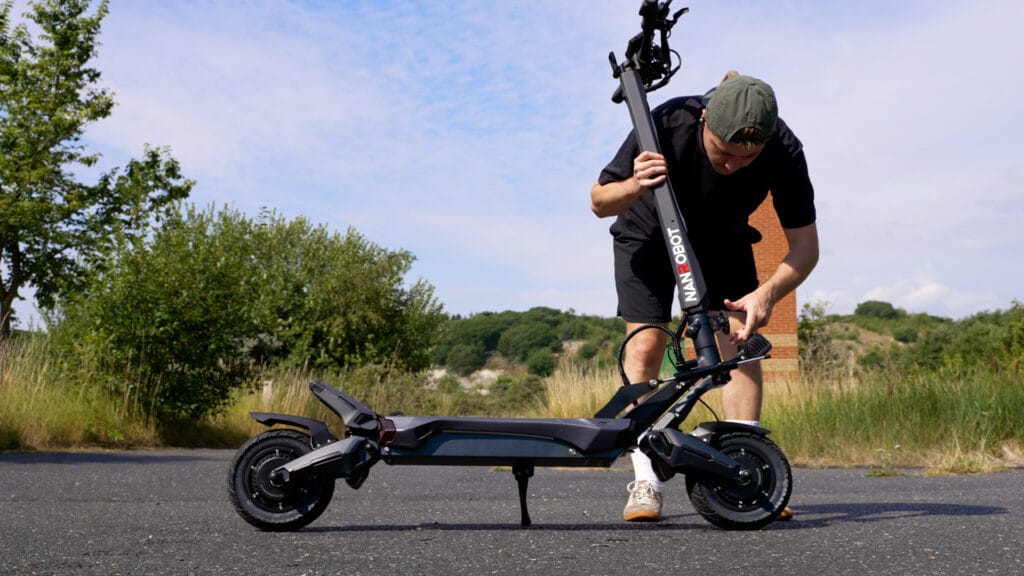
The folding mechanism is one of the better ones I’ve used. It’s a big dial at the base of the stem that you turn like a wheel to loosen or lock the joint. Fold the stem down, and it hooks onto the rear of the deck. It’s easy to crank tight, and there’s zero stem play once it’s locked.
The scooter measures 52.8 x 24.7 x 21.3 inches folded. That’s still 52.8 inches long, so measure your trunk before counting on it fitting.
The one annoyance I have is the headlight, which is right where the stem folds down. You have to tilt it out of the way every time you fold and set it back when you unfold. You get used to it, but it’s a design miss.
Build Quality
Overall build quality is good. I put the folding mechanism through 200 fold-and-unfold cycles to simulate long-term wear, yanking and pulling on the stem along the way, and it’s still rock solid. The frame doesn’t creak, the fenders are thick plastic, and the long kickstand keeps it stable when parked.
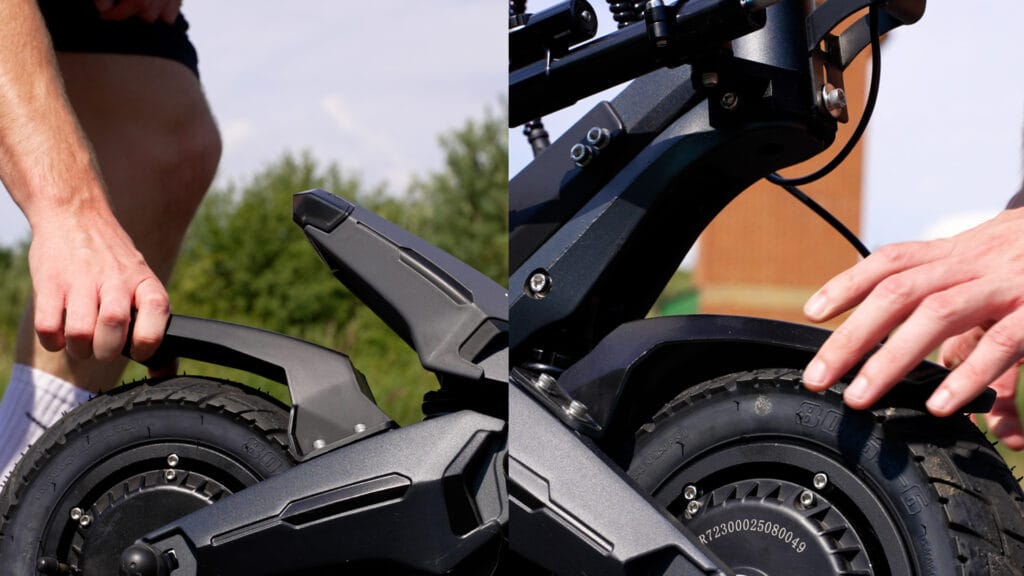
I only have a few gripes. The deck mat edges started peeling on my unit, which looks a bit messy. You can glue them back down with something stronger, but don’t make it permanent, you’ll want to lift the mats later to get at the components underneath. The cable routing could also be a bit cleaner.
As for maintenance/servicing, the motors have a quick-release connector, and the rims are split rims too, which makes tire swaps way easier. Just know the wheel bolts come Loctited from the factory, and you might need an impact gun to break them loose the first time.
Water Resistance
The N6 is IP54 rated. That’s enough for wet roads and the occasional drizzle, and mine held up fine through a ride in moderate rain. Seams look tight, and the internals are encased in protective gel, so the sealing job itself seems solid.
IP54 isn’t class-leading though. If you commute in rain a lot, go for something rated IPX6 or IP66.
Smart Features
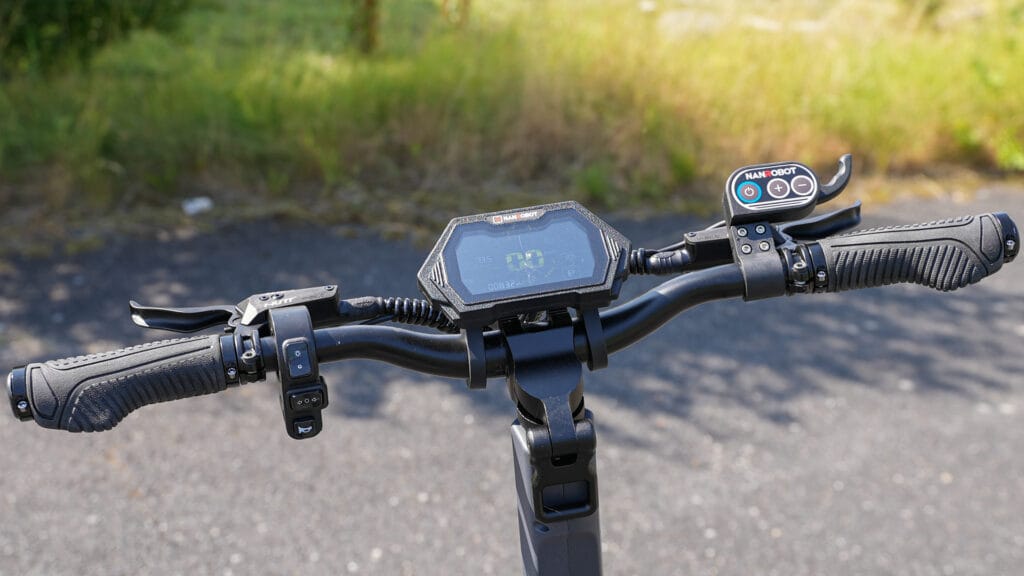
There’s no app for the N6, and honestly, you don’t need one. Everything worth adjusting lives in the P-settings on the display: acceleration strength, regen, top speed cap, zero-start and so on. It’s simple, but it’s got what you need. The manual is alright too and covers the essentials.
Instead of a key, you unlock the N6 with an NFC tag. Hold the power button, tap the tag on the display, squeeze the rear brake, and you’re off. It works fine day to day, and owners clone the tag to rings and phone backs if they want a spare. Leave the scooter idle for 20 seconds and it puts itself back into parking mode.
The display is a TFM13 LCD. There’s some glare in direct sun, but angle it right, and it stays readable.
The 64-color RGB lighting looks cool and does a lot for side visibility at night. My gripe is that it’s controlled with a separate RF remote you have to carry around, which gets annoying fast. Building those controls into the P-settings would’ve been the obvious move.
Being seen at night is no problem between the RGB, the turn signals, the brake light, and the stem light bars. Seeing where you’re going is another story. The headlight sits low and is too weak for these speeds after dark, so if you ride at night, mount an auxiliary light high on the bars.
Final Verdict
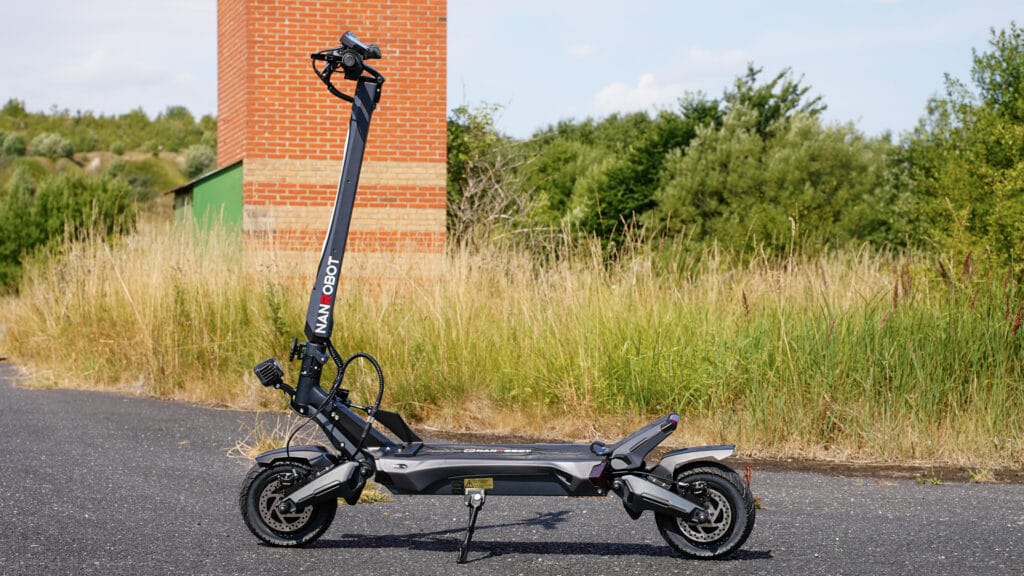
So, is the Nanrobot N6 72V the value king of hyperscooters? I’d say yes. It’s what I’d call a budget hyperscooter. Really powerful, obviously not something that competes with the $3,000 machines, but the performance you get for the price (and the weight) is just excellent.
I’ve had zero issues in over 500 miles. A big part of that is Nanrobot picking proven components, the NUTT brakes, the KKE suspension, the display and the controllers, parts that don’t push the price up but still deliver. My gripes are small. The deck mats peel at the edges, the tires are tubed (add sealant on day one), and you have to tilt the headlight every time you fold.
If you want a 50 mph scooter but don’t wanna spend $2K+, this is the answer.
Buy It If
- You want maximum performance for your money. Nothing we’ve tested comes close at this price point. You’re getting a true 72V system and around 50 real miles of range.
- You’re a heavier rider. It’s rated for 330 lbs, and you can stiffen the suspension to match.
- You’ve got a long commute. I got 49.6 miles at a regular speed. Ridden hard, it does 40.
- You like doing your own maintenance. The quick-release motors and split rims make tire changes easy, and brake pads swap out with a single pin.
Skip It If
- You need to carry it. At 92.6 lbs, this is not a scooter you haul up stairs.
- You want to go faster than 50 mph. Something like the LS7+ 72V goes 60+.
- You ride in rain all the time. IP54 is fine for wet roads, but heavy-rain commuters should look for IP66.
- You want everything perfect out of the box. I recommend adding tube sealant, and an aux light if you ride at night.
Full specifications
Motor Performance
| Top Speed (Tested) | 49.8 mph |
| Top Speed (Claimed) | 50 mph |
| Motor Power | 3000 W |
| Peak Power | 5000 W |
| Voltage | 72 V |
| Motor Config | Dual |
| Hill Grade | 30 ° |
| 0-15 mph | 2.4 s |
| 0-20 mph | 3.8 s |
| 0-25 mph | 5.7 s |
| 0-30 mph | 7.7 s |
| 0-Top | 19.6 s |
Range & Battery
| Range (Fast) | 40.4 mi |
| Range (Tested) | 49.6 mi |
| Range (Slow) | 57.7 mi |
| Range (Claimed) | 81 mi |
| Battery Capacity | 2160 Wh |
| Voltage | 72 V |
| Charge Time | 12 h |
| Battery Type | Lithium-ion |
Ride Quality
| Suspension | Front hydraulic, Rear hydraulic |
| Adjustable Suspension | Yes |
| Tire Type | Tubed |
| Front Tire Size | 10 " |
| Rear Tire Size | 10 " |
| Tire Width | 3 " |
| Deck Length | 22 " |
| Deck Width | 8.3 " |
| Ground Clearance | 6.1 " |
| Handlebar Height (min) | 41.3 " |
| Handlebar Height (max) | 41.3 " |
| Handlebar Width | 24.7 " |
| Footrest | Yes |
| Terrain Type | Hybrid |
Portability & Fit
| Weight | 92.6 lbs |
| Max Rider Weight | 330 lbs |
| Folded Length | 52.8 " |
| Folded Width | 24.7 " |
| Folded Height | 21.3 " |
| Fold Mechanism | Stem |
| mph/lb | 0.54 |
| Wh/lb | 23.33 |
| mi/lb | 0.54 |
Safety
| Front Brake | Disc (Hydraulic) |
| Rear Brake | Disc (Hydraulic) |
| Regen Braking | Yes |
| Brake Distance | 10.6 ft |
| Lights | Both |
| Turn Signals | Yes |
Features
| Features | Speed Modes, Cruise Control, Folding, Push-To-Start, Zero-Start, Turn Signals, Brake Curve Adjustment, Acceleration Adjustment, Speed Limiting, Steering Damper, Electronic Horn, NFC Unlock, Seat Option |
| Display | LCD |
| Throttle | Trigger |
| Kickstand | Yes |
Maintenance
| Tire Type | Tubed |
| IP Rating | IP54 |