
The electric bike is one of the fastest-growing vehicles in America. But with its widespread adoption, injuries are exploding, exceeding 100,000 for the first time in 2025.
People love them for good reason. They ride like bicycles but get you from A to B through hills and headwinds without breaking a sweat. Sales have exploded, cities are building bike lanes, and now parents are putting their children on them.
But federal data shows a dark side that you won’t see in e-bike brand marketing. To fully understand the true cost of the e-bike boom, ERideHero analyzed the latest injury figures in the U.S. and identified the alarming trends they’re following.
What We Did
We used electric bike injury data from the United States Consumer Product Safety Commission’s NEISS Database, which collects data from a sample of around 100 American ER departments, to extrapolate estimated injury figures for the whole of the U.S.
E-bikes first got their own federal product code in 2024, so we classified tens of thousands of earlier incidents to build a consistent injury series back to 2020. Fatality figures come from CPSC’s incident database (CPSRMS). Full methodology at the end of this report.
Key Findings
- E-bike injuries in the U.S. surpassed 100,000 in 2025, reaching an estimated 102,777 ER visits – up 71% in a single year and up 19 times since 2020.
- The proportion of e-bike injuries involving children rose from 10.7% to 16.7% in the past 12 months.
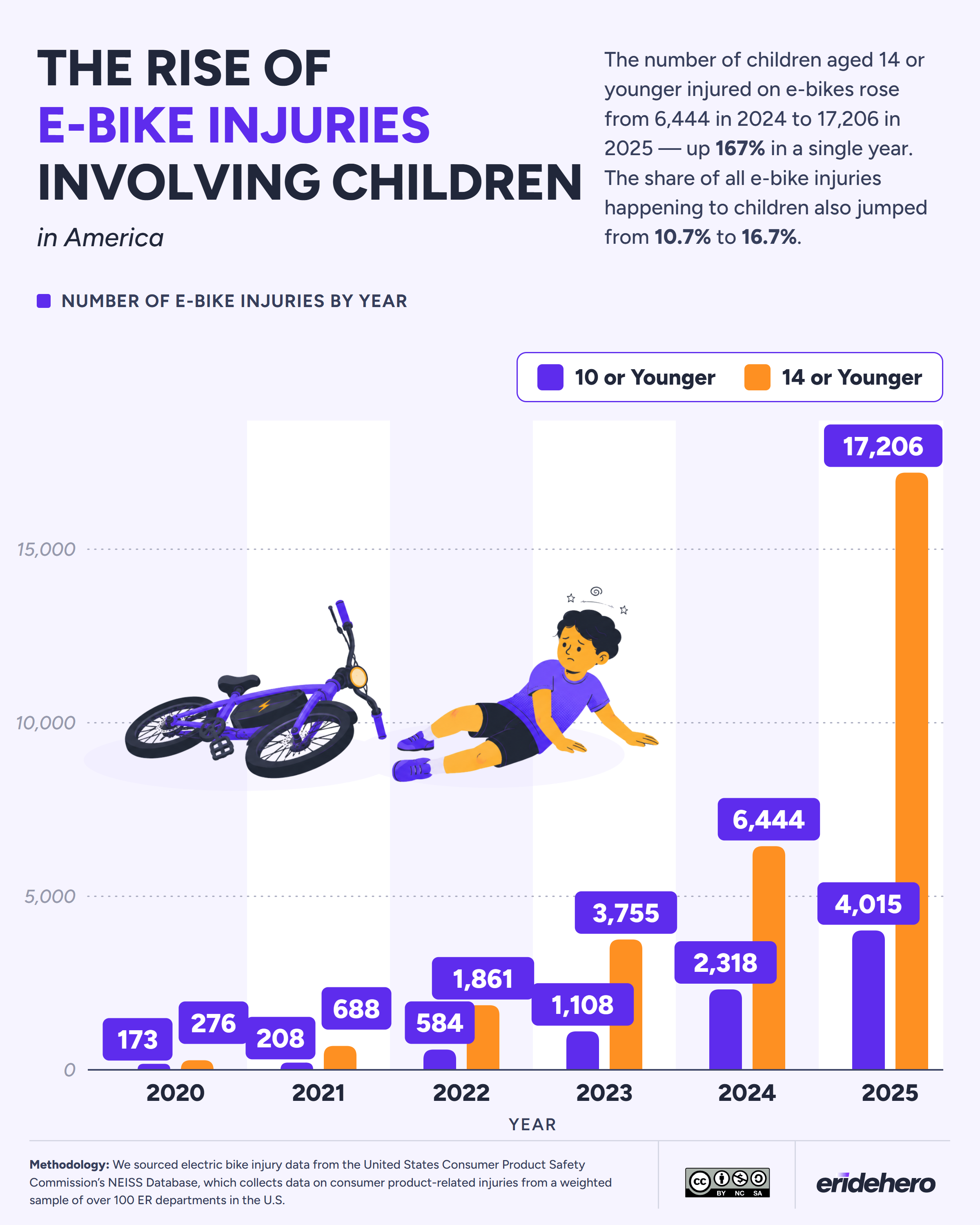
- The number of children aged 14 or younger injured on e-bikes rose from 6,444 in 2024 to 17,206 in 2025 – up 167% in a single year and up 62 times since 2020.
- 17.6% of injuries in 2025 led to hospitalization, a higher rate than for e-scooters (15.1%) and regular bicycles (14.1%).
- In 2025, 29% of e-bike injuries affected the head and/or face, and in CPSC’s follow-up study, only 40% of injured riders wore helmets.
- E-bikes now account for 58% of all micromobility deaths reported to the CPSC. More than half of those involve a car/truck collision.
- Males account for 78.2% of e-bike injuries in 2025.
We test every ride
Independent reviews, buying advice and the real test data behind them. Straight to your inbox.
Join 2,000+ riders


E-Bike Injuries Passed 100,000 for the First Time
First, we looked at the rise in the total number of U.S. e-bike injuries over the past six years.
The figure has risen roughly 19-fold, from an estimated 5,358 in 2020 to 102,777 in 2025. And the curve is steepening, not flattening: injuries rose 78% in 2024 and another 71% in 2025.
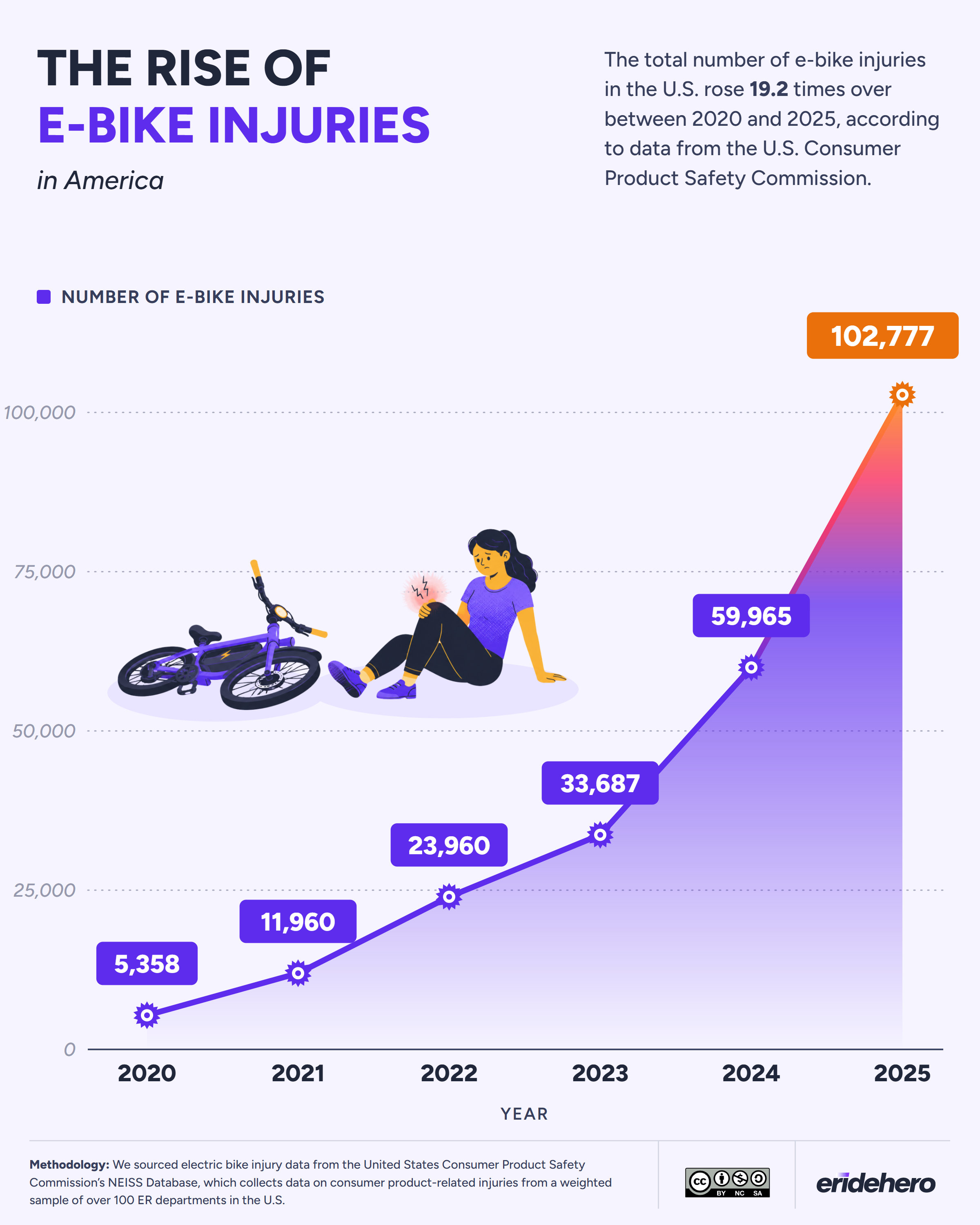
For comparison, e-scooter injuries – the subject of our Electric Scooter Accident Report – grew 5.6 times over the same period. E-bike injuries are growing more than three times faster and, on current trajectories, would overtake e-scooters as America’s most injury-prone micromobility category around 2027.
The trend is echoed in trauma centers. In 2025, e-bike crashes surpassed falls and car accidents to become the No. 1 reason for emergency trauma visits at Rady Children’s. “We basically have kids riding vehicles that are much more like motorcycles than bicycles,” says Dr. Laura Goodman, the hospital’s pediatric trauma medical director.
“We have seen an alarming increase in the number of kids who experienced serious trauma while riding e-bikes and e-scooters,” says Dr. Bryanna Emr, pediatric trauma medical director at Penn State Health Golisano Children’s Hospital. “Kids can go so much faster on these e-bikes and e-scooters than they normally would on a regular pedal bicycle, so they’re getting hit at higher speeds, and their injuries are much worse than we’ve seen in other bicycle or scooter accidents.”
E-Bike Crashes Are More Likely to Put You in the Hospital
The injury numbers are worrying on their own, but they’re also only part of the story.
In 2025, 17.6% of e-bike injuries resulted in hospitalization, transfer, or observation, a notably higher rate than for e-scooters (15.1%) and regular bicycles (14.1%). That number has climbed every single year, from 10.1% in 2020.
The injury profile shows higher severity for e-bike riders. Fractures are the most common e-bike diagnosis at 29% (30,253) in 2025, more severe than on e-scooters, where contusions are most common. Internal injuries account for another 13.8% (14,151) of cases.
E-bikes are heavier than e-scooters and regular bicycles, and most are faster than riders and other road users expect. In CPSC’s 2024 follow-up e-bike injury study, 24% involved a motor vehicle, and 15% of riders were going 20 mph or faster when they crashed.
Child E-Bike Injuries Have Risen 62-Fold Since 2020
The scooter report’s most troubling finding – children taking a growing share of injuries – is even more dramatic on e-bikes.
Injuries to riders 14 and under went from an estimated 276 in 2020 to 17,206 in 2025. That’s a 62-fold increase, including a jump from 6,444 to 17,206 (+167%) in the last year alone. Children’s share of all e-bike injuries has tripled from 5.2% in 2020 to 16.7% in 2025.
ER physicians describe the shift in stark terms. Dr. Cornelia Griggs, a pediatric surgeon at Mass General Brigham for Children, told WBUR that “every single time I am on call, there is a trauma activation for a child injured on or by an e-bike.” At UMass Memorial Medical Center, pediatric orthopedic surgeon Dr. Errol Mortimer estimates “close to a tenfold increase” in ER visits for children hurt on e-bikes in a single year.
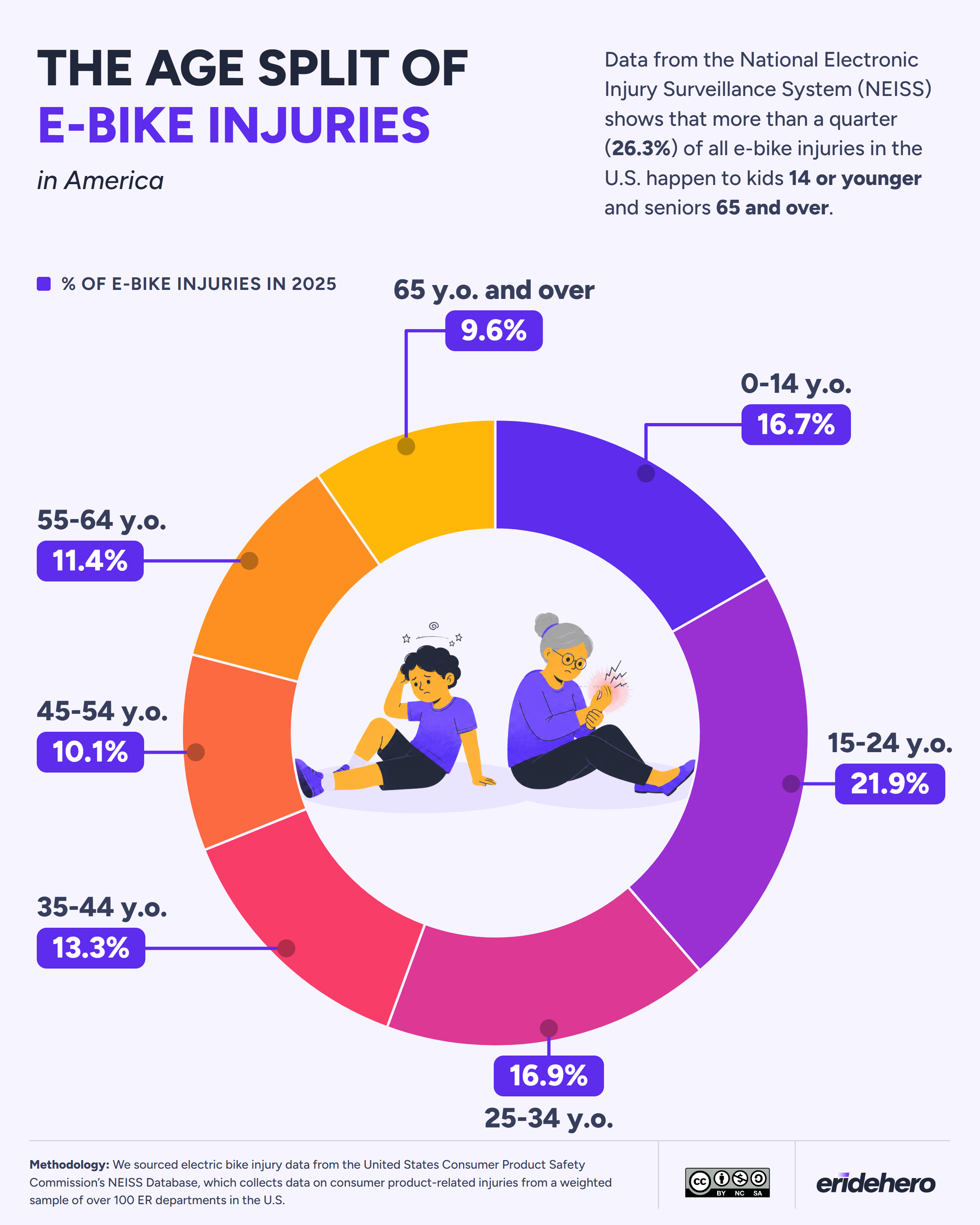
Across all age groups, the injury curve skews towards young e-bike riders. Riders aged 15–24 account for the largest share of 2025 injuries (21.9%), and more than half of all injured riders were 34 or younger.
Part of the problem is a regulatory gray zone: many “e-bikes” marketed to teenagers are capable of moped speeds while being sold, legally, as bicycles. Trauma surgeons writing in the American College of Surgeons Bulletin note that in the U.S., children “are allowed to operate devices capable of 20–28 mph – and, when illegally modified, more than 50 mph – without formal training.”
“We can fix broken bones, but when your head or your brain is injured, that is often very hard to recover from and can be life-changing,” says Dr. Elizabeth Murray, a pediatric emergency physician at UR Medicine Golisano Children’s Hospital.
Heads Take the Hardest Hits
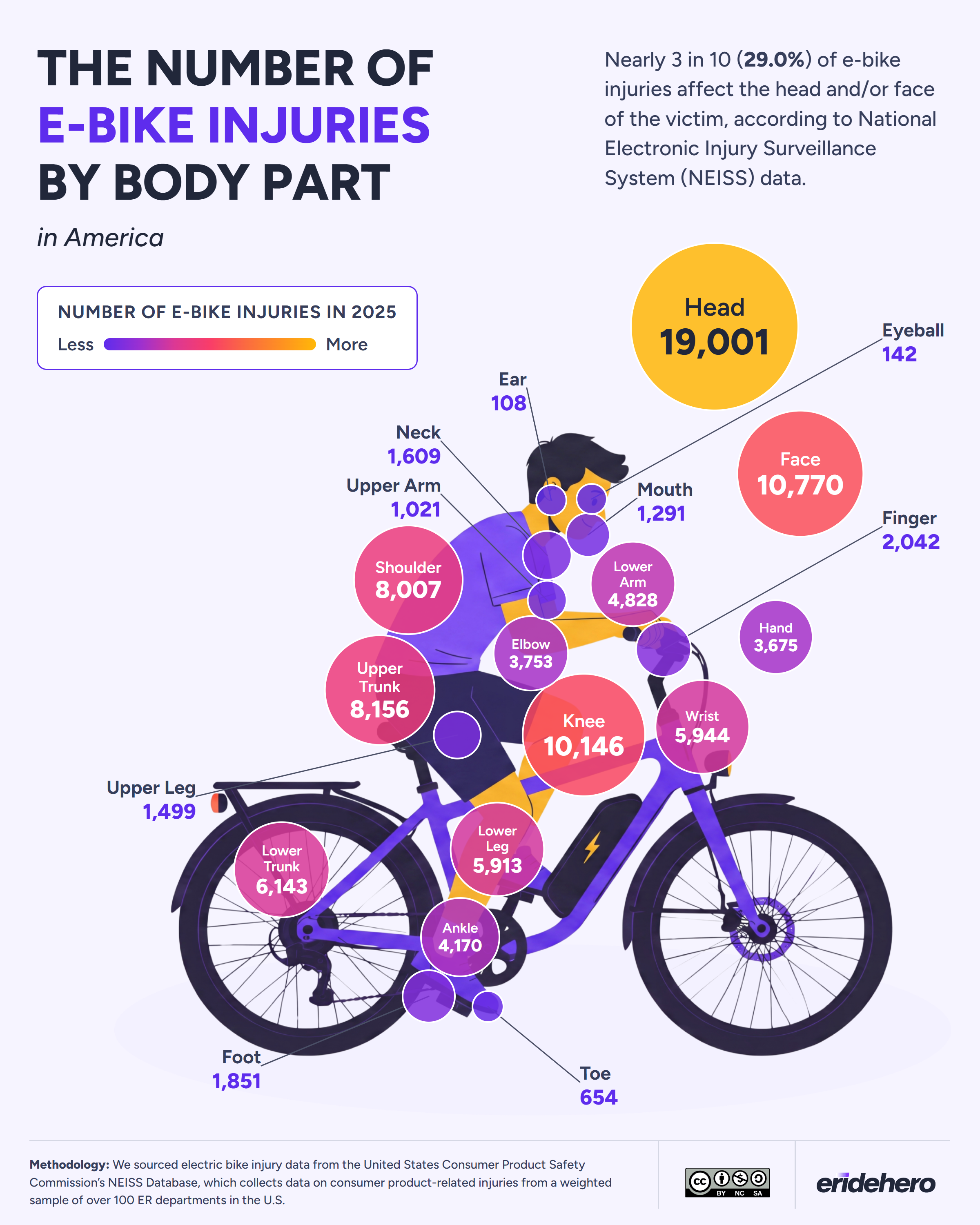
As with e-scooters, the head is the most commonly injured body part, with 19,001 estimated injuries in 2025, or 18.5% of the total. Add the face (10,770), and nearly 3 in 10 (29%) of e-bike injuries affect the region above the neck.
Sadly, helmets remain an exception, not a rule. CPSC conducted a follow-up study in 2024 and found that only 40% of injured e-bike riders were wearing a helmet. Our own analysis of 2025 injury narratives that mention helmet use points in the same direction. 57% report riding without a helmet, a higher rate than for regular bicycle riders at 48%.
Nearly 4 in 5 Injured Riders Are Male
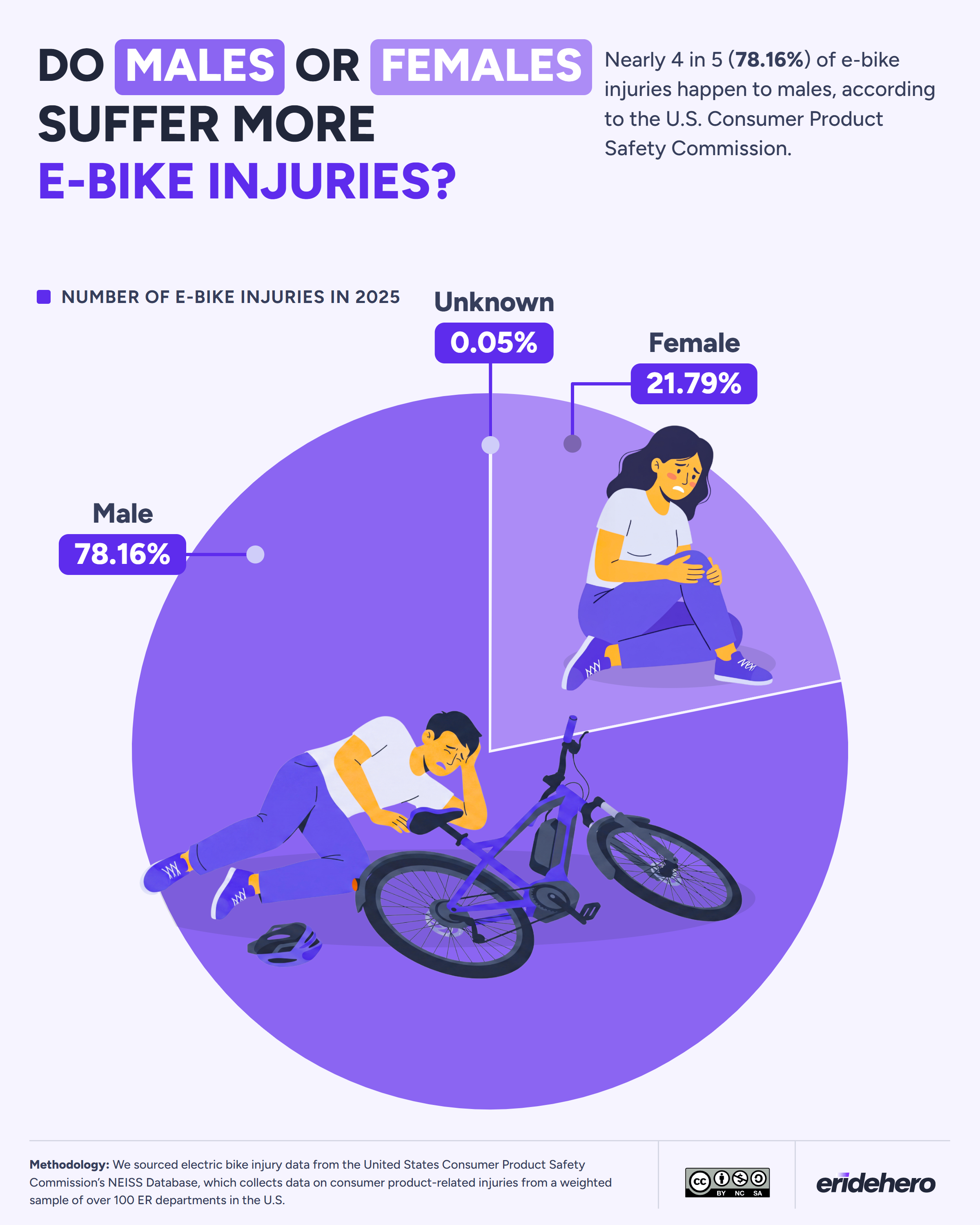
Males make up the majority of injured e-bike riders, accounting for 78.2% of all injuries in 2025. That share has held steady between 74% and 79% year-on-year since 2020.
That imbalance carries through to the worst outcomes. 82% of e-bike rider deaths between 2017 and 2024 were male.
E-Bike Deaths Have Gone From Zero to Nearly 100 a Year
The NEISS data cover what happens at the ER, but to fully understand e-bike fatalities, we turned to the CPSC’s incident database, which compiles death certificates, medical examiner reports, and investigation reports, spanning 2017-2024.
CPSC didn’t record a single e-bike death in 2017. In 2024, the annual toll was 97, with 310 deaths across the eight-year period. E-bikes now account for 58% of all micromobility fatalities, far ahead of e-scooters (39%), despite seeing fewer injuries.
170 of the 310 deaths (55%) were collisions with motor vehicles. Loss of control, or crashing into obstructions, accounts for another 61. Lithium-ion battery fires killed 19 people, and 19 more deaths involved pedestrian collisions.
We also looked at road-traffic exposure. Of all 2025 e-bike injuries with a recorded location, 81% occurred on a street or highway.
The battery-fire-related deaths prompted the CPSC to propose America’s first mandatory lithium-ion battery safety standard for micromobility products in June 2026.
Injuries Skew Young, Deaths Skew Old
Here is the report’s most counterintuitive finding: the riders filling ERs and the riders filling morgues are different people.
E-bike injuries concentrate around young people. In 2025, 55% of injured riders were 34 or younger. But e-bike deaths concentrate on older riders: 82% of micromobility riders 65 or older who died between 2017 and 2024 were on e-bikes. If you add the 45-64 bracket, older adults make up over half of all e-bike fatalities.
Research backs up that pattern. A German trauma center study found that almost all e-bike riders in need of intensive care for severe brain injury were older men (average age 77), and not a single one of them was wearing a helmet.
And the mechanics behind it explain why. E-bikes let people ride faster and farther. That’s a gift for older riders with mobility issues, but slower reflexes and more fragile bones also make them more susceptible to serious injury.
Summer Fridays Are Peak Danger
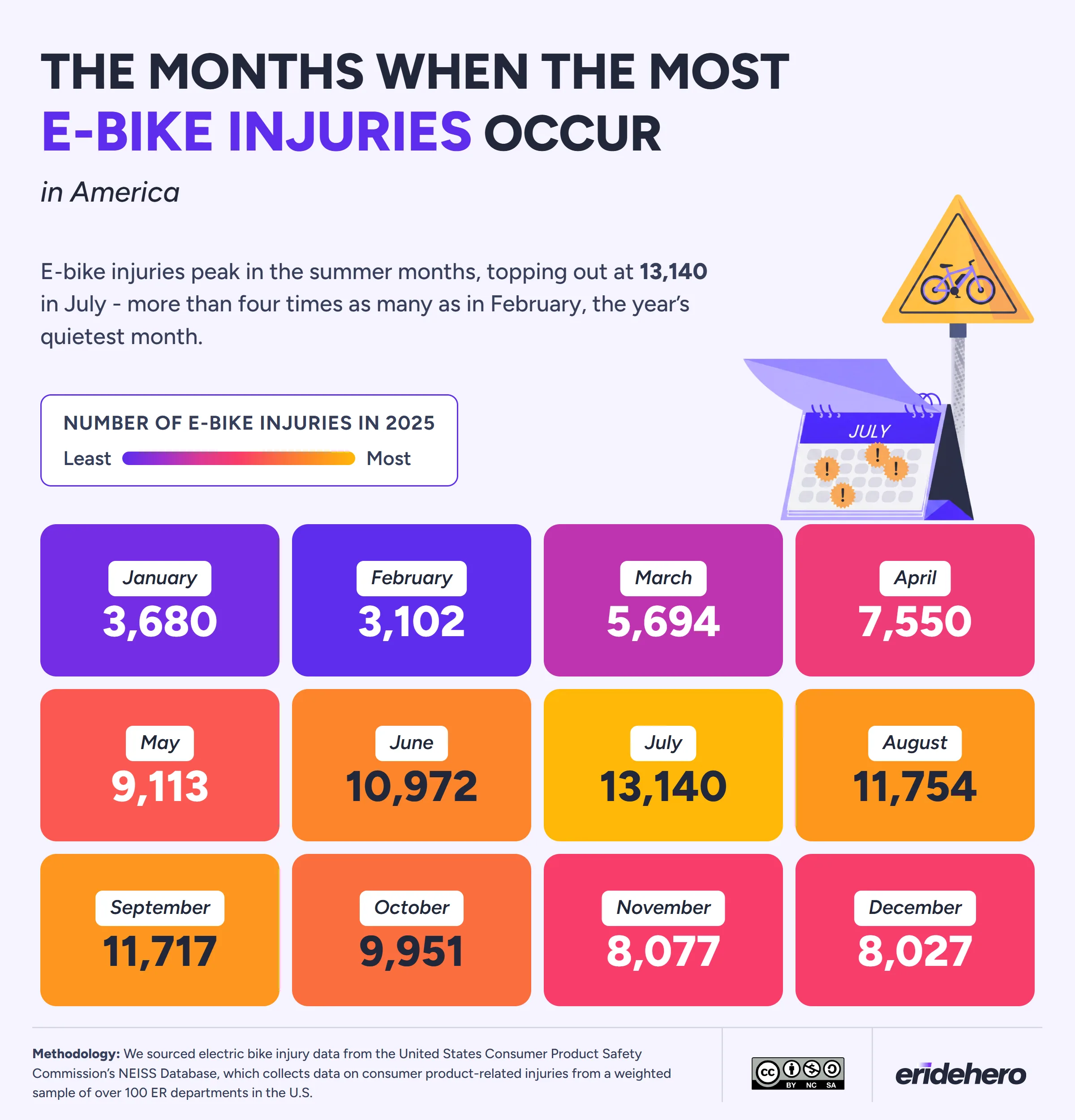
Most e-bike injuries happen in the summer months. July 2025 peaked at 13,140 injuries, more than four times February’s year-low of 3,102.
Interestingly, where e-scooter injuries pile up on weekends, e-bike injuries are spread almost evenly across the week. Friday is the worst single day (16,739), while Saturday and Sunday combined account for just 30% of injuries.
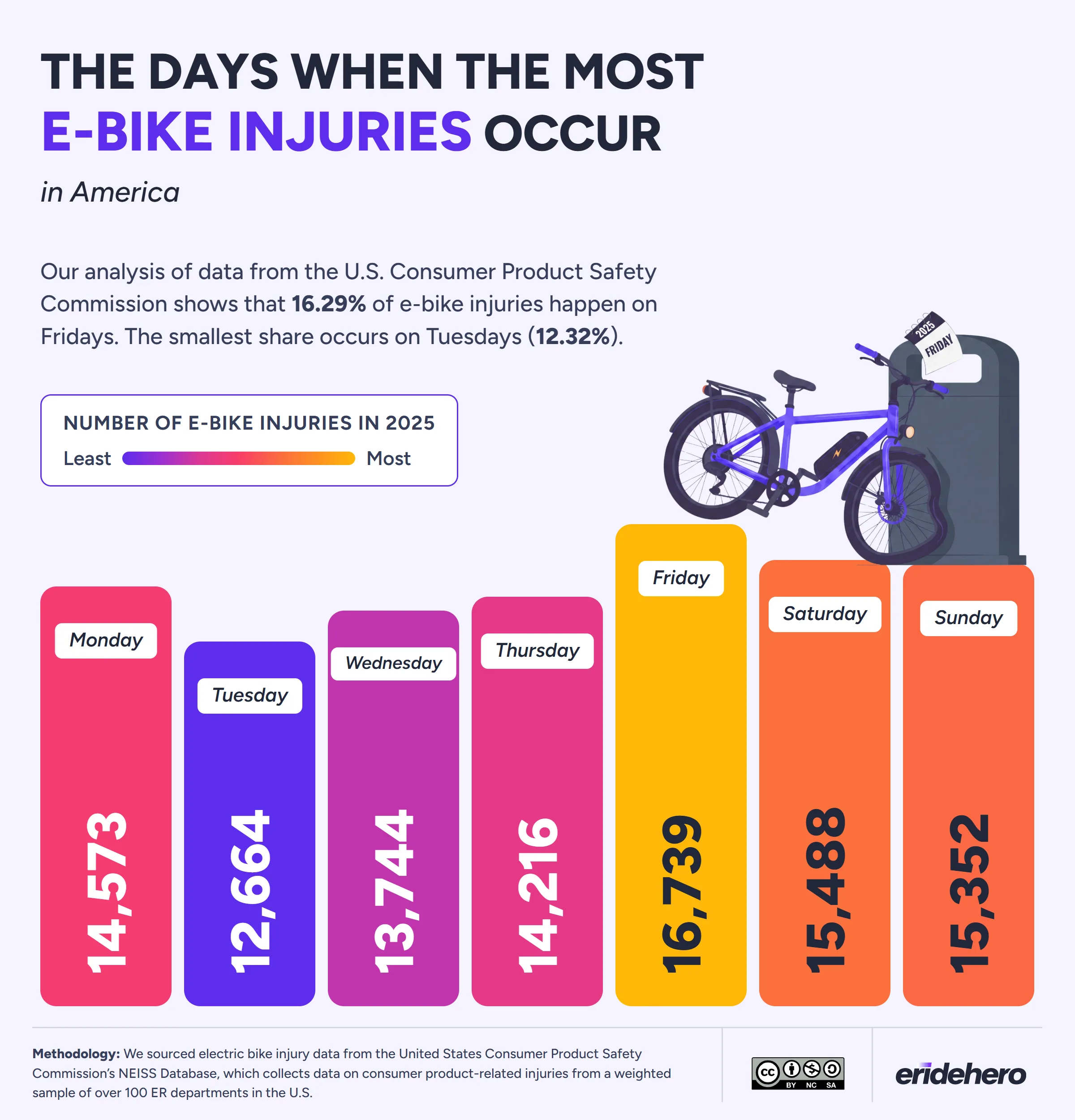
The flatter profile suggests e-bikes are more frequently used as a daily mode of transportation than for weekend recreation. While it’s a clear sign that the technology and adoption are maturing, it also means greater exposure to rush-hour traffic five days a week.
Alcohol Plays a Smaller Role Than You’d Think
Of all 102,777 e-bike injuries in 2025, an estimated 6,471 (6.3%) involved alcohol, and 1,412 (1.4%) involved recreational drugs. Those proportions have remained steady in recent years and broadly match what we see in the e-scooter landscape.
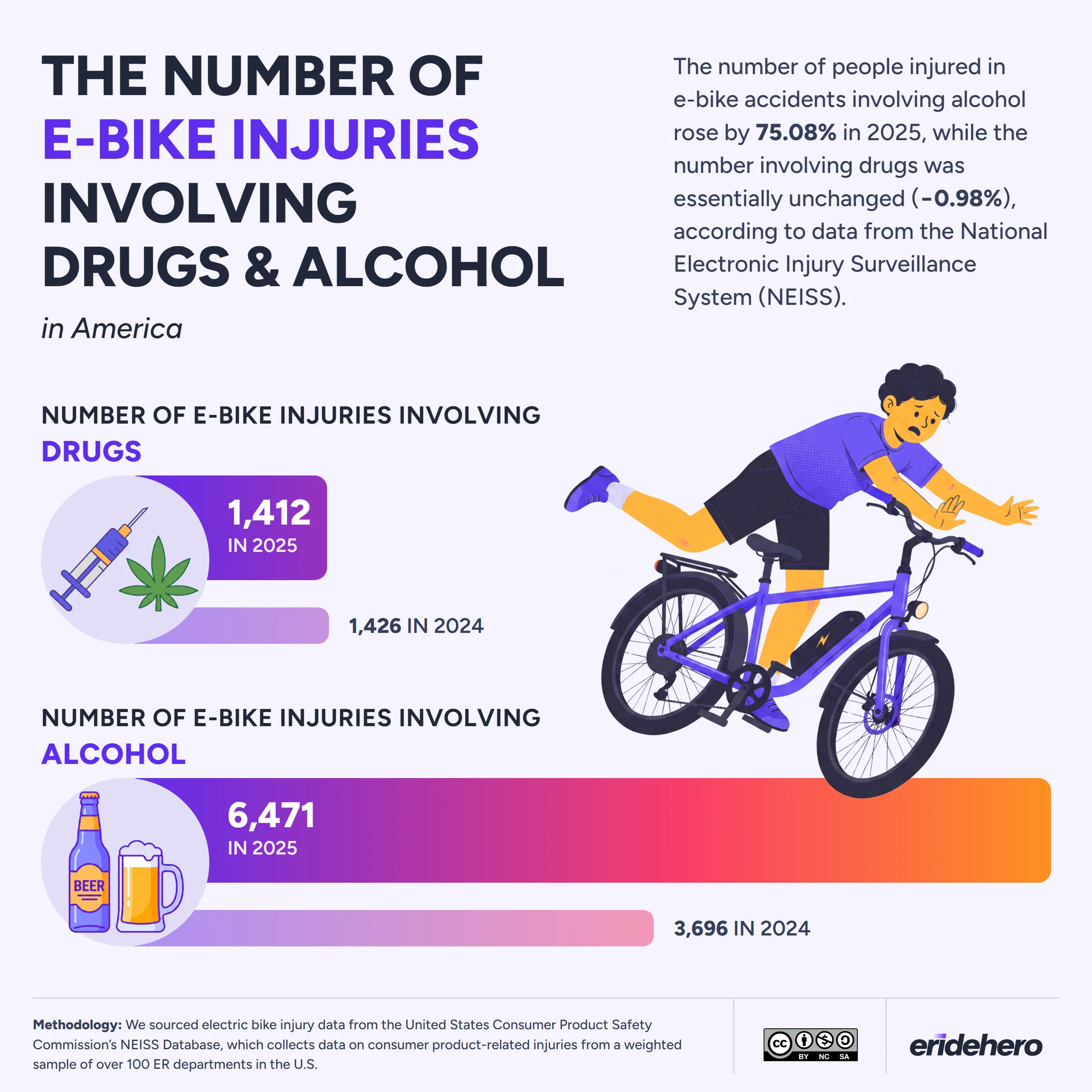
It’s a problem, but not a growing one. Proportionally, cases involving recreational drugs actually dropped from 2.4% in 2024 to 1.4% in 2025.
So if vices aren’t driving the issue, what is? Our take is fast e-bikes, heavy traffic that isn’t used to them, and a flood of new riders still learning their limits.
Fast Bikes, Young Riders, Old Victims
Micromobility has the potential to be one of the greatest headlines of the coming decades. E-bikes can transform transportation in our cities for the better and be part of the solution to the world’s carbon emissions crisis. For that to happen, infrastructure, awareness, and regulations must follow.
But today, however, we’re seeing technology that has outrun its (lack of) regulations. E-bikes didn’t get their own federal injury code until 2024, and many states still don’t distinguish between a pedal-assisted 250-watt e-bike and a 750-watt throttle e-bike capable of doing 28 mph. Plenty of unregulated models can do even more, and the safety culture built around regular bikes hasn’t kept up.
Until regulations and habits catch up, the burden of the protective decision falls on riders.
- Always wear a helmet – head injuries lead every category of this report
- Treat car traffic as the primary threat: it causes over half of all e-bike deaths
- Match the bike to the rider – a Class 3 e-bike is not a child's bicycle
- Practice braking at speed before you need it; e-bikes are heavier and faster than they feel
- Use lights and reflectives – CPSC's follow-up study tied 1 in 10 injuries to poor visibility
- Never ride under the influence
- Charge with the supplied charger, and never charge a damaged battery indoors
The streets are a communal space. How you ride shapes both the safety of the people around you and the habits of the millions of e-bike riders who will follow.
Our Methodology
We sourced electric bike injury data from the U.S. Consumer Product Safety Commission’s NEISS Database, which collects consumer product-related injury data from a sample of around 100 ER departments across the U.S. The database provides statistical weights for each injury entry, enabling us to extrapolate national estimates.
Prior to 2024, e-bikes shared a product code with mopeds, so we classified the narrative text of every record under the legacy code (2020-2023) to isolate e-bike incidents. We used conservative word rules and excluded ambiguous “motorized bike” cases. From 2024, we used the CPSC’s dedicated e-bike product codes. Our approach mirrors CPSC’s own coding rule, and our 2024 estimate (59,965) is within 1.3% of CPSC’s published 2024 estimate (59,200). Estimates for 2020 are based on a smaller sample of records and should be treated as approximate. All injury figures are floors: several hundred records per year describing e-bikes remain coded as ordinary bicycles and were not counted.
Fatality figures are drawn from CPSC’s Consumer Product Safety Risk Management System (CPSRMS), as reported in the agency’s April 2026 micromobility report. Death-certificate reporting lags by up to two years, so 2023–2024 fatality counts will likely rise in future revisions.
This data analysis was completed in August 2026.